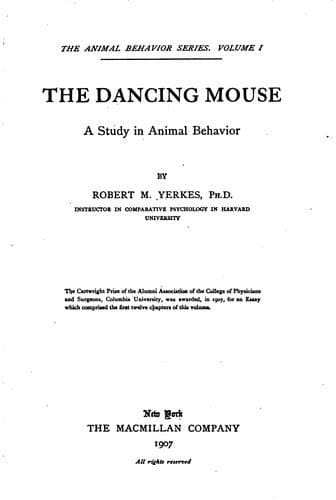
The Dancing Mouse: A Study in Animal BehaviorYerkes, Robert Mearns
Science
The Dancing Mouse: A Study in Animal Behavior
Yerkes, Robert Mearns
Animal behavior; Dancing mice
The initiative of the dancer certainly varies with its age. In scope the
action system rapidly increases during the first few months of life, and
if the animal be subjected to training tests, this increase may continue
well into old age. The appearance of noticeable quiescence does not
necessarily indicate diminished initiative. Frequently my oldest mice have
shown themselves preëminent in their ability to adjust their behavior to
new conditions. However, I have not studied individuals of more than
eighteen months in age. One would naturally expect initiative to decrease
in senility. All that I can say is that I have seen no indications of it.
We may now briefly consider the principal sex differences which have been
revealed by the experiments. In sensitiveness I have discovered no
difference, but it should be stated that no special attention has been
given to the matter. In docility the males usually appeared to be superior
to the females. This was especially noticeable early in my visual
discrimination tests. The males almost invariably acquired a perfect habit
quicker than the females. I may cite the following typical instances.
Number 14 acquired the black-white habit with 40 tests; No. 13, with 60
(Table 10, p. 109). Of the five pairs of individuals whose records in
white-black training appear in Table 43, not one contradicts the statement
which has just been made. It is to be noted, however, that under certain
conditions of training, for example, 20 tests per day, the female is at an
advantage. Recently I have with increasing frequency obtained measures of
docility which apparently favor the female. That this difference in the
results is due to a difference in age is probable.
In labyrinth tests the female is as much superior to the male as the male
is to the female in discrimination tests. From the tables of Chapter XIII
I may take a few averages to indicate the quantitative nature of this
difference. A degree of proficiency in labyrinth B attained by the males
after 7.0 trials was equaled by the females after 6.2 trials. In labyrinth
C the males acquired a habit as a result of 18.7 trials; the females, as a
result of 13.8. And similarly in labyrinth D, 6.1 trials did no more for
the males than 5.9 did for the females.
That at the age of about one month the male dancer should be able to
acquire a visual discrimination habit more rapidly than the female,
whereas the female can acquire a labyrinth habit more readily than the
male, suggests an important difference in the nature of their equipment
for habit formation. One might hazard the suggestion that the male depends
more largely upon discrimination of external conditions, whereas the
female depends to a greater extent than does the male upon the internal,
organic changes which are wrought by acts. At any rate the female seems to
follow a labyrinth path more mechanically, more accurately, more easily,
and with less evidence of sense discrimination than does the male.
Public-domain text, read in full here on John Shaqi.
Reviews
Reviews
No reviews yet
Be the first to share your thoughts on this work.
Elsewhere in the archive
Join the Discussion
Join the discussion
Sign in to leave a comment or review.
Sign InorCreate an account