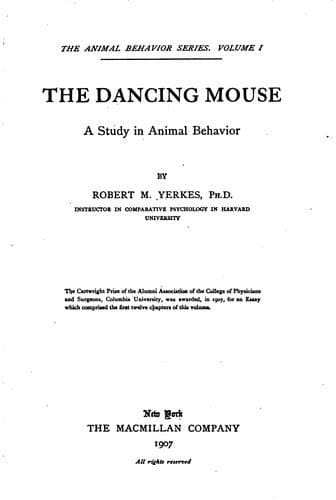
The Dancing Mouse: A Study in Animal BehaviorYerkes, Robert Mearns
Science
The Dancing Mouse: A Study in Animal Behavior
Yerkes, Robert Mearns
Animal behavior; Dancing mice
Finally, in concluding this chapter, I may add that in those aspects of
behavior which received attention in the early chapters of this volume the
dancers differ very markedly. Some climb readily on vertical or inclined
surfaces to which they can cling; others seldom venture from their
horizontally placed dance floor. Some balance themselves skillfully on
narrow bridges; others fall off almost immediately. My own observations,
as well as a comparison of the accounts of the behavior of the dancer
which have been given by Cyon, Zoth, and other investigators, lead me to
conclude that there are different kinds of dancing mice. This may be the
result of crosses with other species of mice, or it may be merely an
expression of the variability of an exceptionally unstable race.
I can see no satisfactory grounds for considering the dancer either
abnormal or pathological. It is a well-established race, with certain
peculiarities to which it breeds true; and no pathological structural
conditions, so far as I have been able to learn, have been discovered.
I have presented in this chapter on differences a program rather than a
completed study. To carry out fully the lines of work which have been
suggested by my observations and by the presentation of results would
occupy a skilled observer many months. I have not as yet succeeded in
accomplishing this, but my failure is not due to lack of interest or of
effort.
CHAPTER XVIII
THE INHERITANCE OF FORMS OF BEHAVIOR
In a general way those peculiarities of behavior which suggested the name
dancing mouse are inherited. Generation after generation of the mice run
in circles, whirl, and move the head restlessly and jerkily from side to
side. But these forms of behavior vary greatly. Some individuals whirl
infrequently and sporadically; others whirl frequently and persistently,
at certain hours of the day. Some are unable to climb a vertical surface;
others do so readily. Some respond to sounds; others give no indications
of ability to hear. I propose in this chapter to present certain facts
concerning the inheritance of individual peculiarities of behavior, and to
state the results of a series of experiments by which I had hoped to test
the inheritance of individually acquired forms of behavior.
My study of the nature of the whirling tendency of the dancer has revealed
the fact that certain individuals whirl to the right almost uniformly,
others just as regularly to the left, and still others now in one
direction, now in the other. On the basis of this observation, the animals
have been classified as right, left, or mixed whirlers. Does the dancer
transmit to its offspring the tendency to whirl in a definite manner?
Public-domain text, read in full here on John Shaqi.
Reviews
Reviews
No reviews yet
Be the first to share your thoughts on this work.
Elsewhere in the archive
Join the Discussion
Join the discussion
Sign in to leave a comment or review.
Sign InorCreate an account