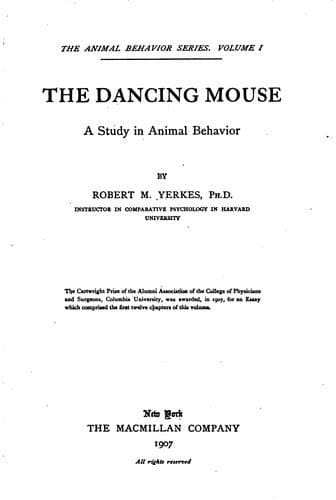
The Dancing Mouse: A Study in Animal BehaviorYerkes, Robert Mearns
Science
The Dancing Mouse: A Study in Animal Behavior
Yerkes, Robert Mearns
Animal behavior; Dancing mice
First generation No. 152, Left whirler No. 151, Left whirler
Second generation No. 410, Left whirler No. 415, Right whirler
Third generation No. 420, Left whirler No. 425, Left whirler
One line of descent exhibited no pronounced whirling tendency; the other
exhibited a strong tendency to whirl to the left. Are these statements
true for the group of one hundred individuals whose distribution among the
three classes of whirlers has been given? In order to obtain an answer to
this question I have reclassified these individuals according to descent
and direction of whirling.
INDIVIDUALS OF THE 200 LINE
RIGHT WHIRLERS LEFT WHIRLERS MIXED WHIRLERS TOTAL
Males 7 6 8 21
Females 5 8 8 21
12 14 16 42
INDIVIDUALS OF THE 400 LINE
RIGHT WHIRLERS LEFT WHIRLERS MIXED WHIRLERS TOTAL
Males 4 9 1 14
Females 6 9 4 19
10 18 5 33
INDIVIDUALS OF MIXED DESCENT
9 10 6 25
Three interesting facts are indicated by these results: first, the
inheritance of a tendency to whirl to the left in the 400 line of descent;
second, the lack of any definite whirling tendency in the 200 line; and
third, the occurrence of right and left whirlers with equal frequency as a
result of the crossing of these two lines of descent.
It is quite possible, and I am inclined to consider it probable, that the
pure dancer regularly inherits a tendency to whirl to the left, and that
this is obscured in the case of the 200 line by the influences of a cross
with another variety of mouse. It is to be noted that the individuals of
the 200 line were predominantly mixed whirlers, and I may add that many of
them whirled so seldom that they might more appropriately be classed as
circlers.
THE INHERITANCE OF INDIVIDUALLY ACQUIRED FORMS OF
BEHAVIOR
The white-black discrimination experiments which were made in connection
with the study of vision and the modifiability of behavior were so planned
that they should furnish evidence of any possible tendency towards the
inheritance of modifications in behavior. The problem may be stated thus.
If a dancing mouse be thoroughly trained to avoid black, by being
subjected to a disagreeable experience every time it enters a black box,
will it transmit to its offspring a tendency to avoid black?
Public-domain text, read in full here on John Shaqi.
Reviews
Reviews
No reviews yet
Be the first to share your thoughts on this work.
Elsewhere in the archive
Join the Discussion
Join the discussion
Sign in to leave a comment or review.
Sign InorCreate an account