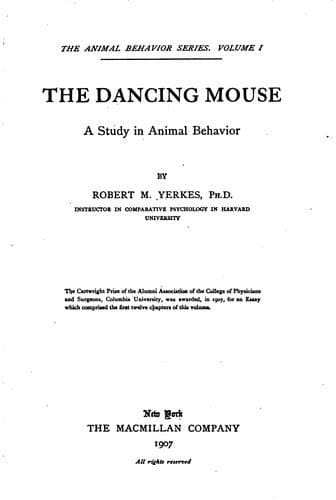
The Dancing Mouse: A Study in Animal BehaviorYerkes, Robert Mearns
Science
The Dancing Mouse: A Study in Animal Behavior
Yerkes, Robert Mearns
Animal behavior; Dancing mice
Records of the direction of whirling of one hundred individuals have been
obtained. For twenty of these mice the determination was made by counting
the number of complete turns in five-minute intervals at six different
hours of the day. For the remaining eighty individuals the direction was
discovered by observation of the activity of the animals for a brief
interval at five different times. Naturally, the former results are the
more exact; in fact, they alone have any considerable quantitative value.
But for the problem under consideration all of the determinations are
sufficiently accurate to be satisfactory.
The distribution of the individuals which were examined as to direction of
whirling is as follows.
RIGHT WHIRLERS LEFT WHIRLERS MIXED WHIRLERS TOTAL
Males 19 19 12 50
Females 12 23 15 50
The frequency of occurrence of left whirlers among the females is
unexpectedly high. Is this to be accounted for in terms of inheritance? In
my search for an answer to this question I followed the whirling tendency
from generation to generation in two lines of descent. These two groups of
mice have already been referred to as the 200 line and the 400 line. The
former were descended from Nos. 200 and 205, and the latter from Nos. 152
and 151. Individuals which resulted from the crossing of these lines will
be referred to hereafter as of mixed descent. There were some striking
differences in the behavior of the mice of the two lines of descent. As a
rule the individuals of the 200 line climbed more readily, were more
active, danced less vigorously, whirled less rapidly and less
persistently, and were in several other respects much more like common
mice than were the individuals of the 400 line. It is also to be noted
(see Table 5) that few of the litters of the 200 line exhibited auditory
reactions, whereas almost all of the litters of the 400 line which were
tested gave unmistakable evidence of sensitiveness to certain sounds.
These differences at once suggest the importance of an examination of the
whirling tendency of each line of descent.
The results for the several generations of each line which I had
opportunity to examine are unexpectedly decisive so far as the question in
point is concerned.
INDIVIDUALS OF THE 200 LINE
MALES FEMALES
First generation No. 200, ? No. 205, ?
Second generation No. 210, Mixed whirler No. 215, Left whirler
Third generation No. 220, Mixed whirler No. 225, Mixed whirler
Fourth generation No. 230, Right whirler No. 235, Mixed whirler
Fifth generation No. 240, Right whirler No. 245, Left whirler
INDIVIDUALS OF THE 400 LINE
MALES FEMALES
Public-domain text, read in full here on John Shaqi.
Reviews
Reviews
No reviews yet
Be the first to share your thoughts on this work.
Elsewhere in the archive
Join the Discussion
Join the discussion
Sign in to leave a comment or review.
Sign InorCreate an account