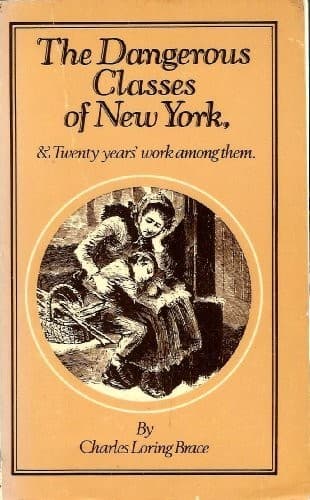
The Dangerous Classes of New York, and Twenty Years' Work Among ThemBrace, Charles Loring
History
The Dangerous Classes of New York, and Twenty Years' Work Among Them
Brace, Charles Loring
Child welfare -- New York (State) -- New York; New York (N.Y.) -- Social conditions; Poor -- New York (State) -- New York
The East River Industrial School (at No. 206 East Fortieth Street)
still continues its humble but profound labors of love. Mrs. Hurley is
still there, the "Mend of the poor" for miles around, carrying sympathy,
advice, and assistance to thousands of unbefriended creatures, and
teaching faithfully all day in the School. Two gentlemen have especially
aided her in providing food and clothing for her little ones; and the
lady-volunteers still give liberally of their means and time. May the
School long shine as a light in one of the dark places of the city.
CHAPTER XV.
THE PROTESTANT POOR AND STREET-ROVERS.
It is not often that our efforts carry us among Protestant poor, but it
happens that on the west side of the city, near Tenth Avenue and
Twenty-seventh Street, is a considerable district of English and Scotch
laboring people, who are mainly Protestants.
A meeting of ladies was called in the western part of the city, in like
manner with the proceedings at the formation of the other Schools; and a
School was proposed. The wife of a prominent property-holder in the
neighborhood, a lady of great energy of character, Mrs. R. R., took a
leading part, and greatly aided the undertaking; other ladies joined,
and the result was the formation of the
HUDSON RIVER INDUSTRIAL SCHOOL,
the fourth of our Schools founded in 1854. With all these Schools, in
the beginning, the ladies themselves raised all the funds for their
support, and, as I have related, devoted an incredible amount of time to
aiding in them, there being usually, however, two salaried teachers.
The experience in the Edinburgh Ragged Schools, I was assured, when
there, was, that you cannot depend on volunteer help after the first
enthusiasm has passed by. This is not our experience.
As one set of "volunteers" have withdrawn or leave the work, others
appear, and there are still in this and some of our other Industrial
Schools, most active and efficient voluntary helpers. Gradually,
however, the support and supervision of the Schools fell more and more
into the hands of the central authority--The Children's Aid Society.
The obtaining a share in the Common School Fund enabled the Society to
do more for these useful charities and to found new ones.
In the Hudson River School, it cannot be said that the Protestant poor
proved much better than the Catholic; in fact, it has often seemed to me
that when a Protestant is reduced to extreme poverty, and, above all, a
Yankee, he becomes the most wretched and useless of all paupers. The
work and its results were similar on the west side to those in the other
districts which I have already described.
"MUSCULAR ORPHANS."
Public-domain text, read in full here on John Shaqi.
Reviews
Reviews
No reviews yet
Be the first to share your thoughts on this work.
Elsewhere in the archive
Join the Discussion
Join the discussion
Sign in to leave a comment or review.
Sign InorCreate an account