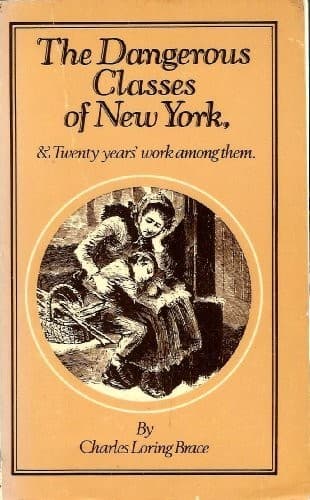
The Dangerous Classes of New York, and Twenty Years' Work Among ThemBrace, Charles Loring
History
The Dangerous Classes of New York, and Twenty Years' Work Among Them
Brace, Charles Loring
Child welfare -- New York (State) -- New York; New York (N.Y.) -- Social conditions; Poor -- New York (State) -- New York
Our attention had thus far been directed mainly to girls in these
Industrial School efforts. They seemed the class exposed to the most
terrible evils, and besides, through our other enterprises, we were
sheltering, teaching, and benefiting for life vast numbers of lads.
We determined now to try the effect of industry and schooling on the
roving boys, and I chose a district where we had to make head against a
"sea of evils." This was in the quarter bordering on East Thirty-fourth
Street and Second Avenue. There seemed to be there a society of
irreclaimable little vagabonds. They hated School with an
inextinguishable hatred; they had a constitutional love for smashing
windows and pilfering apple-stands. They could dodge an "M. P." as a fox
dodges a hound; they disliked anything so civilized as a bed-chamber,
but preferred old boxes and empty barns, and when they were caught it
required a very wide-awake policeman, and such an Asylum-yard as hardly
exists in New York, to keep them.
I have sometimes stopped, admiringly, to watch the skill and cunning
with which the little rascals, some not more than ten years old, would
diminish a load of wood left on the docks; the sticks were passed from
one to another, and the lad nearest the pile was apparently engaged
eagerly in playing marbles. If the woodman's attention was called to his
loss, they were off like a swarm of cockroaches.
[Illustration: STREET ARABS.]
We opened a School with all the accessories for reaching and pleasing
them; our teacher was a skillful mechanic, a young man of excellent
judgment and hearty sympathy with boys; he offered to teach them
carpentering and box-making and pay them wages. Common-school lessons
were given, also, and a good warm meal provided at noon. We had
festivals and magic-lantern exhibitions and lectures. We taught, and we
fed and clothed. In return, they smashed our windows; they entered the
premises at night and carried off everything they could find; they
howled before the door, and yelled "Protestant School!" We arrested one
or two for the burglary, as a warning, but the little flibbertigibbets
escaped from the police like rats, and we let them go with the fright
they had had. Some few of the worst we induced to go to the country, and
others we had arrested as vagrants, without appearing ourselves, until a
kind of dark suspicion spread among them against the writer that he had
the power of spiriting away bad boys to distant regions by some
mysterious means. Those that did go to the country proved of the kind
called by a Western paper "muscular orphans," for an unfortunate
employer undertaking to administer corporal punishment to two of them,
the little vagabonds turned and chastised him and then fled.
The following case is noted in our Journal of these up-town boys:
A HARD CASE REFORMED.
Public-domain text, read in full here on John Shaqi.
Reviews
Reviews
No reviews yet
Be the first to share your thoughts on this work.
Elsewhere in the archive
Join the Discussion
Join the discussion
Sign in to leave a comment or review.
Sign InorCreate an account