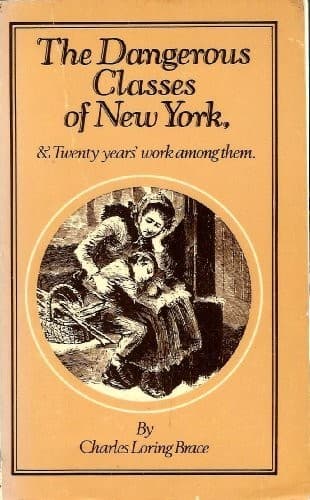
The Dangerous Classes of New York, and Twenty Years' Work Among ThemBrace, Charles Loring
History
The Dangerous Classes of New York, and Twenty Years' Work Among Them
Brace, Charles Loring
Child welfare -- New York (State) -- New York; New York (N.Y.) -- Social conditions; Poor -- New York (State) -- New York
The consequence was, that children were months and years in taking the
first steps in education--such as learning to read--because they had
begun wrong. They had no accurate habits of observation, and, as a
natural result, soon fell into loose habits of thinking. What they knew
they knew vaguely. When their acquirements were tested they were found
valueless. The simplest principles of mathematics were almost unknown to
them, because they had learned the science by rote, and had never
exercised their minds on it. They could apply none of them. Algebra,
instead of being an implement, was of no more practical use to them than
Sanscrit would be. Geometry was as abstract as metaphysics. They had
never learned it by solid figures, or studied it intelligently. Grammar
was a memorized collection of dry abstract rules and examples. Natural
history was only a catalogue, and geography a dictionary learned by
heart.
Our manufacturers, who had occasion in former years, to employ these
youths from our Public Schools, found them utterly incompetent for using
their faculties on practical subjects. Nor did they go forth with minds
expanded, and ready to receive the germs of knowledge which might be, as
it were, floating in the atmosphere. Their faculties had not been
aroused.
The "Object System" attempts to lay down the principles which have been
tested in primary education, in the form of a Science; so that the
teacher not gifted with the genius of invention and the talent for
conveying knowledge shall be able to awaken and train the child's
intellect as if he were.
Its first principle is to exercise the senses, but never during any long
period at once. The play of the children is so contrived as to employ
their sense of touch, of weight, and of harmony. Colors are placed,
before them, and they are trained in distinguishing the different
delicate shades--in the recognition of which children are singularly
deficient. Numbers are taught by objects, such as small beans or
marbles, and then when numerals are learned, regular tables of addition
and subtraction are written on the board by the teacher at the dictation
of the scholar.
The great step in all education is the learning the use of that
wonderful vehicle and symbol of human thought, the printed word.
Public-domain text, read in full here on John Shaqi.
Reviews
Reviews
No reviews yet
Be the first to share your thoughts on this work.
Elsewhere in the archive
Join the Discussion
Join the discussion
Sign in to leave a comment or review.
Sign InorCreate an account