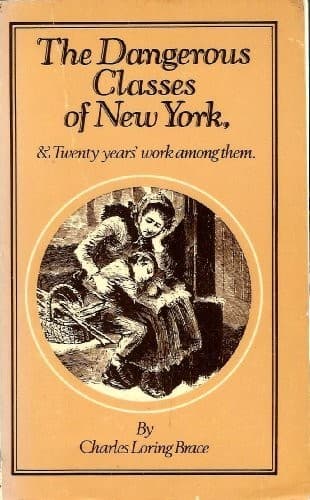
The Dangerous Classes of New York, and Twenty Years' Work Among ThemBrace, Charles Loring
History
The Dangerous Classes of New York, and Twenty Years' Work Among Them
Brace, Charles Loring
Child welfare -- New York (State) -- New York; New York (N.Y.) -- Social conditions; Poor -- New York (State) -- New York
Here the object system has made the greatest advance. The English
language has the unfortunate peculiarity of a great many sounds to each
vowel, and of an utter want of connection between the name and the sound
of the letter. No mature mind can easily appreciate the dark and
mysterious gulf which, to the infant's view, separates the learning the
letters and reading. The two seem to be utterly different acquirements.
The new methods escape the difficulty in part by not teaching the names,
but the sounds, of the letters first, and then leading the child to put
his sounds together in the form of a word, and next to print the word on
the black-board, the teacher calling on the scholar to find a similar
one in a card or book. By this ingenious device, the modern infant,
instead of being whipped into reading, is beguiled into it pleasantly
and imperceptibly, and makes his progress by a philosophical law. He
reads before he knows it. But here the obstacle arises that each vowel,
printed in the same type, has so many sounds. One ingenious teacher. Dr.
Leigh, obviates this by printing on his charts each vowel-sound in a
slightly different form, and giving the silent letters in hair-lines.
The objection here might be that the scholar learns a type different
from that in common use. Still, the deviation from the ordinary alphabet
is so slight as probably not to confuse any young mind, and the learner
can go on by a philosophical classification of sounds. Other teachers
indicate the different vowel-sounds by accents.
One well-known writer on the "Object System," Mr. Caulkins, seems to
approve of what we are inclined to consider even more philosophical
still--the learning the word first, and the letters and spelling
afterward.
Most children in cultivated families learn to read in this way. The word
is a symbol of thought--a thing in itself--first, perhaps, connected
with a picture of the object placed at its side, but afterward becoming
phonetic, representing arbitrarily any object by its sound. Then other
words are learned--not separately, but in association, as one learns a
foreign language. Farther on, the pupil analyzes, spells, considers each
letter, and notes each part of speech.
An objection may occur here, that the habit of correct and careful
spelling will not be so well gained by this method as by the old.
Mr. Caulkins's remarks on this topic in his Manual on "Object Lessons"
are so sensible that we quote them _in extenso:--_
THE A B C METHOD.
Public-domain text, read in full here on John Shaqi.
Reviews
Reviews
No reviews yet
Be the first to share your thoughts on this work.
Elsewhere in the archive
Join the Discussion
Join the discussion
Sign in to leave a comment or review.
Sign InorCreate an account