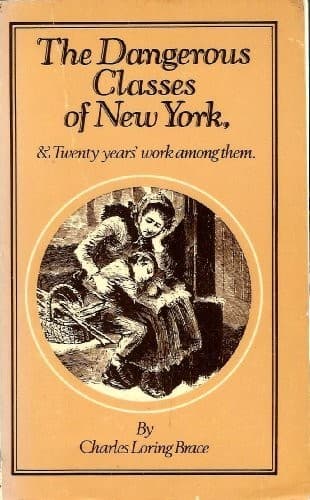
The Dangerous Classes of New York, and Twenty Years' Work Among ThemBrace, Charles Loring
History
The Dangerous Classes of New York, and Twenty Years' Work Among Them
Brace, Charles Loring
Child welfare -- New York (State) -- New York; New York (N.Y.) -- Social conditions; Poor -- New York (State) -- New York
The beginning of the higher mathematics may be taught children perfectly
well under this method. Straight lines and angles are drawn, or
constructed with little sticks, and named, and various figures thus
formed. With blocks, the different geometrical figures are constructed
and named--all being finished by the pupils themselves. On the
blackboard certain lines are given, and with them "inventive drawing"
goes on under the pupil's own suggestion.
Weights and measures are learned by practical illustrations with real
objects, and are thus not easily forgotten.
Definition is very agreeably taught by the teacher's producing some
object, say, an apple, and then making each scholar describe some
quality of it, in taste, color, form, or material, and then write this
word on the board. Very difficult adjectives, such as "opaque," or
"pungent," or "translucent," or "aromatic," may thus be learned, besides
all the simpler, and learned permanently.
The old bugbear to children, spelling, is by no means so terrible under
these methods. The teacher writes two initial consonants, say, "th," and
each scholar makes a new word with them, and it is written on the board;
or a terminal consonant is given, or certain combinations of letters are
written down--say, _ough,_ in "though" and words of corresponding sound
must be written underneath, or the different sounds of each vowel must
be illustrated by the scholar, and the varying sounds of consonants, and
so on endlessly--spelling becoming a perfect amusement, and, at the same
time, training the pupil in many delicate shades of sound, and in
analyzing and remembering words.
Grammar is conveyed, not by that farce in teaching, and that cross to
all children, grammatical rules, which are, in fact, the expressions of
the final fruit of knowledge, but the teacher writes incorrectly on the
blackboard, both in spelling, punctuation, and grammar, and the children
must correct this; thus learning from the senses and usage, instead of
from abstract rules. Reading is given as nearly as possible in
conversational tones, and the old loud, mechanical sing-song is
forbidden.
The principle most insisted on in all this system is, that the child
should teach himself as far as possible; that his faculties should do
the work, and not the teacher's; and the dull and slow pupil is
especially to be led on and encouraged. But, as might be supposed, the
teacher's task, under the object method, is no sinecure. She can no
longer slip along the groove of mechanical teaching. She must be
wide-awake, inventive, constantly on the _qui vive_ to stir up her
pupils' minds. The droning over lessons, and letting children repeat,
parrot-like, long lists of words, is not for her. She must be always
seeking out some new thing and making her pupils observe and think for
themselves. Her duty is a hard one. But this is the only true teaching;
and we trust that no Primary School in New York will be without a
well-trained "Object-teacher."
Public-domain text, read in full here on John Shaqi.
Reviews
Reviews
No reviews yet
Be the first to share your thoughts on this work.
Elsewhere in the archive
Join the Discussion
Join the discussion
Sign in to leave a comment or review.
Sign InorCreate an account