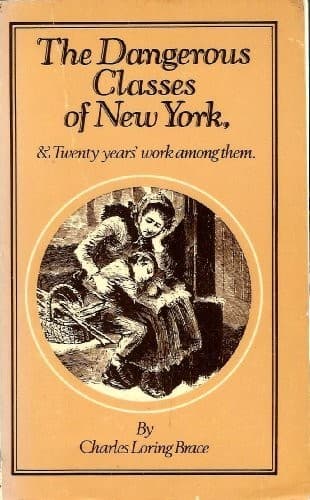
The Dangerous Classes of New York, and Twenty Years' Work Among ThemBrace, Charles Loring
History
The Dangerous Classes of New York, and Twenty Years' Work Among Them
Brace, Charles Loring
Child welfare -- New York (State) -- New York; New York (N.Y.) -- Social conditions; Poor -- New York (State) -- New York
It began with a "Boys' Meeting," under Mr. Macy, a practical
philanthropist, of whom I shall speak again.
The quarter is a very notorious one, and contains numbers of idle and
vagrant boys and girls. The success of Mr. Macy with the meeting, and
the experience he gained there of a wild class of girls induced him and
his sisters to attempt in 1859 to found a School for girls; to this was
gradually added a "Free Reading-room," a library, and various temperance
and other associations. Ladies of position and wealth were attracted to
it, as well as others, from seeing the quiet and earnest nature of the
work done; there was no show or "blowing of trumpets," or any great
expense, but there were two or three men and women connected with it who
evidently thought night and day of the rough boys and miserable girls
that attended it; who felt no toil too great, if it could truly benefit
these unfortunate creatures.
The lady-volunteers seemed to catch the same spirit of Christian
sacrifice and earnestness. One who has since become a missionary in a
distant heathen land, poured out here for these American heathen some of
the best years of her youth in the most enthusiastic and constant
labors.
Others visited the homes of the poor, some taught in the classes, and
all labored with their own hands to arrange the festivals and dinners
which they provided so freely for the needy children. For twelve years
now those young ladies or their friends have wrought, unceasingly at
this labor of love.
The great burden of the School, however, fell on Miss Macy, a woman of
long experience with this class, and a profound and intense spirit of
humanity. I never shall forget the scene (as reported to me) when, at
the opening of the School, after the July riots in 1863 against the
colored people, a deputation of hard-looking, heavy-drinking Irish
women, the mothers of some twenty or thirty of the children, waited on
her to demand the exclusion of some colored children. In the most
amiable and Quaker-like manner, but with the firmness of the old Puritan
stock from which she sprung, she assured them that, if every other
scholar left, so long as that school remained it should never be closed
to any child on account of color. They withdrew their children, but soon
after returned them.
Like the other Schools, the Cottage Place gives a great deal of
assistance to the poor, but it does so in connection with education, and
therefore creates no pauperism.
Public-domain text, read in full here on John Shaqi.
Reviews
Reviews
No reviews yet
Be the first to share your thoughts on this work.
Elsewhere in the archive
Join the Discussion
Join the discussion
Sign in to leave a comment or review.
Sign InorCreate an account