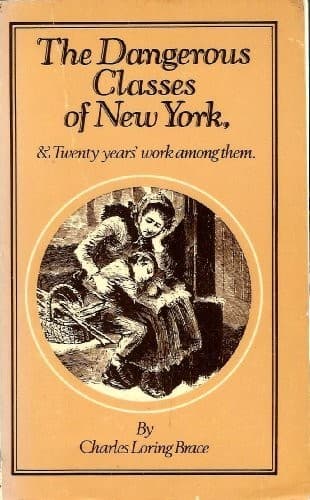
The Dangerous Classes of New York, and Twenty Years' Work Among ThemBrace, Charles Loring
History
The Dangerous Classes of New York, and Twenty Years' Work Among Them
Brace, Charles Loring
Child welfare -- New York (State) -- New York; New York (N.Y.) -- Social conditions; Poor -- New York (State) -- New York
The same experience is passed through here as under the other Schools.
The children are nearly all the offspring of drunkards, but they do not
themselves drink as they grow up. The slovenly learn cleanliness, the
vagrant industry, the careless punctuality and order. Thieving was very
prevalent in the School when it was founded; now it is never known. All
have been beggars; but, as they improve under teaching, and when they
leave their homes, they never follow begging as a pursuit. Hardly a
graduate of the School, whether boy or girl, is known who has become a
thief, or beggar, or criminal, or prostitute. Such is the power of daily
kindness and training, of Christianity early applied.
Outside of the School, great numbers of lads are brought under the
influence of the "Bands of Hope," the "Reading-room," and the lectures
and amusements offered them.
The result of all this has been noticed by the neighboring manufacturers
in the moral improvement of the Ward.
THE LITTLE BEGGARS OF THE FIRST WARD.
One of the eye-sores which used to trouble me was the condition of the
city behind Trinity Church. Often and often have I walked through
Greenwich and Washington Streets, or the narrow lanes of the quarter,
watching the ragged, wild children flitting about; or have visited the
damp underground basements which every high tide flooded, crowded with
men, women, and children; or climbed to the old rookeries, packed to the
smallest attic with a wretched population, and have wished so that
something might be done for this miserable quarter, which is in a Ward
where more wealth is accumulated than in any other one place in
America.
First I induced our Board to send a careful agent through the district,
to collect exact statistics. Then an application was made to the wealthy
Corporation of Trinity Church, to assist or to found some charitable
enterprise for this wretched population under the shadow of its spire.
For two years we continued these applications, but without avail. Then
it occurred to me that we should try the business-men who were daily
passing these scenes of misery and crime.
Fortunately, I struck upon a young merchant of singular
conscientiousness of purpose, who had felt for a long time the sad evils
of the Ward. With him I addressed another gentleman of a well-known
elevation of character, and a certain manly persistency that led him
never to turn back when he had "put his hand to the plow." A few
personal friends joined them, and I soon saw that we were secure of the
future. Our leader had a great social influence, and he at once turned
it to aid his philanthropic scheme; he himself, gave freely, and called
upon his friends for money. The School was founded in 1860, and at once
gathered in a large number of the waifs of the First Ward, and has had a
like happy influence with our other Schools.
Public-domain text, read in full here on John Shaqi.
Reviews
Reviews
No reviews yet
Be the first to share your thoughts on this work.
Elsewhere in the archive
Join the Discussion
Join the discussion
Sign in to leave a comment or review.
Sign InorCreate an account