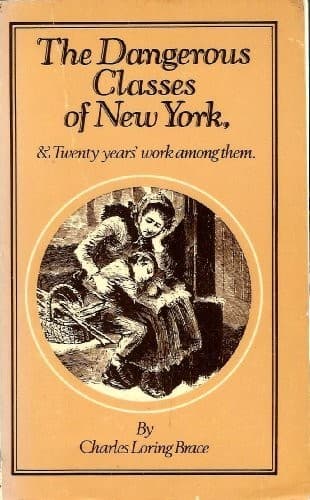
The Dangerous Classes of New York, and Twenty Years' Work Among ThemBrace, Charles Loring
History
The Dangerous Classes of New York, and Twenty Years' Work Among Them
Brace, Charles Loring
Child welfare -- New York (State) -- New York; New York (N.Y.) -- Social conditions; Poor -- New York (State) -- New York
order that she may be able to keep up with her classes. But I think this
has been a work worth doing, and I especially feel it to be so now, as I
am employed in this retrospect.
"I am often asked by my friends, who think the child is little more than
half-witted, why I do not 'send her back, and get a brighter one.' My
answer is, that she is just the one who needs the care and kindness
which Providence has put it into my power to bestow. We love her dearly;
but, if I did not, I should not think of sending her back to such a
place as your great city. She is just one of those who could be imposed
upon and abused, and perhaps may never be able to take care of herself
wholly."
Having found the defects of our first plan of emigration, we soon
inaugurated another, which has since been followed out successfully
during nearly twenty years of constant action.
We formed little companies of emigrants, and, after thoroughly cleaning
and clothing them, put them under a competent agent, and, first
selecting a village where there was a call or opening for such a party,
we dispatched them to the place.
The farming community having been duly notified, there was usually a
dense crowd of people at the station, awaiting the arrival of the
youthful travelers. The sight of the little company of the children of
misfortune always touched the hearts of a population naturally generous.
They were soon billeted around among the citizens, and the following day
a public meeting was called in the church or town-hall, and a committee
appointed of leading citizens. The agent then addressed the assembly,
stating the benevolent objects of the Society, and something of the
history of the children. The sight of their worn faces was a most
pathetic enforcement of his arguments. People who were childless came
forward to adopt children; others, who had not intended to take any into
their families, were induced to apply for them; and many who really
wanted the children's labor pressed forward to obtain it.
Public-domain text, read in full here on John Shaqi.
Reviews
Reviews
No reviews yet
Be the first to share your thoughts on this work.
Elsewhere in the archive
Join the Discussion
Join the discussion
Sign in to leave a comment or review.
Sign InorCreate an account