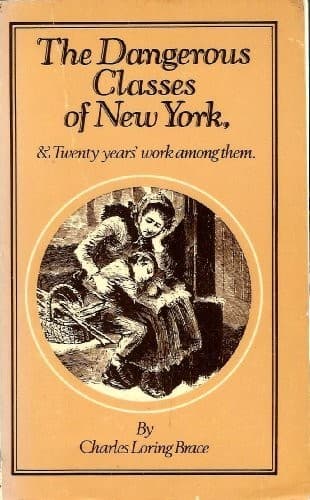
The Dangerous Classes of New York, and Twenty Years' Work Among ThemBrace, Charles Loring
History
The Dangerous Classes of New York, and Twenty Years' Work Among Them
Brace, Charles Loring
Child welfare -- New York (State) -- New York; New York (N.Y.) -- Social conditions; Poor -- New York (State) -- New York
In every American community, especially in a Western one, there are many
spare places at the table of life. There is no harassing "struggle for
existence." They have enough for themselves and the stranger too. Not,
perhaps, thinking of it before, yet, the orphan being placed in their
presence without friends or home, they gladly welcome and train him. The
committee decide on the applications. Sometimes there is almost a case
for Solomon before them. Two eager mothers without children claim some
little waif thus cast on the strand before them. Sometimes the family
which has taken in a fine lad for the night feels that it cannot do
without him, and yet the committee prefer a better home for him. And so
hours of discussion and selection pass. Those who are able, pay the
fares of the children, or otherwise make some gift to the Society until
at length the business of charity is finished, and a little band of
young wayfarers and homeless rovers in the world find themselves in
comfortable and kind homes, with all the boundless advantages and
opportunities of the Western farmer's life about them.
CHAPTER XX.
PROVIDING COUNTRY HOMES.
THE OPPOSITION TO THIS REMEDY--ITS EFFECTS.
This most sound and practical of charities always met with an intense
opposition here from a certain class, for bigoted reasons. The poor were
early taught, even from the altar, that the whole scheme of emigration
was one of "proselytizing" and that every child thus taken forth was
made, a "Protestant." Stories were spread, too, that these unfortunate
children were re-named in the West, and that thus even brothers and
sisters might meet and perhaps marry! Others scattered the pleasant
information that the little ones "were sold as slaves," and that the
agents enriched themselves from the transaction.
These were the obstacles and objections among the poor themselves. So
powerful were these, that it would often happen that a poor woman,
seeing her child becoming ruined on the streets, and soon plainly to
come forth as a criminal, would prefer this to a good home in the West;
and we would have the discouragement of beholding the lad a thief behind
prison-bars, when a journey to the country would have saved him. Most
distressing of all was, when a drunken mother or father followed a
half-starved boy, already scarred and sore with their brutality, and
snatched him from one of our parties of little emigrants, all joyful
with their new prospects, only to beat him and leave him on the
streets.
Public-domain text, read in full here on John Shaqi.
Reviews
Reviews
No reviews yet
Be the first to share your thoughts on this work.
Elsewhere in the archive
Join the Discussion
Join the discussion
Sign in to leave a comment or review.
Sign InorCreate an account