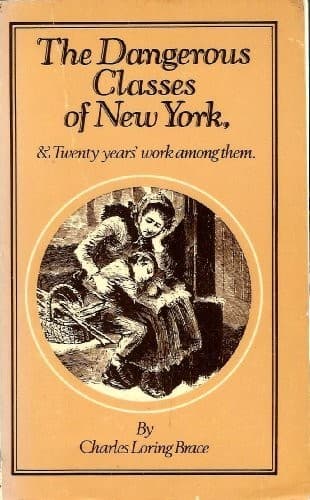
The Dangerous Classes of New York, and Twenty Years' Work Among ThemBrace, Charles Loring
History
The Dangerous Classes of New York, and Twenty Years' Work Among Them
Brace, Charles Loring
Child welfare -- New York (State) -- New York; New York (N.Y.) -- Social conditions; Poor -- New York (State) -- New York
One test, which I used often to administer to myself, as to our
different systems, was to ask--and I request any Asylum advocate to do
the same--"If your son were suddenly, by the death of his parents and
relatives, to be thrown out on the streets, poor and homeless--as these
children are--where would you prefer him to be placed--in an Asylum, or
in a good farmer's home in the West?"
"The plainest farmer's home rather than the best Asylum--a thousand
times!" was always my sincere answer.
Our discussion waxed warm, and was useful to both sides. Our weak point
was that, if a single boy or girl in a village, from a large company we
had sent, turned out bad, there was a cry raised that "every New-York
poor child," thus sent out, became "a thief or a vagabond," and for a
time people believed it.
Our antagonists seized hold of this, and we immediately dispatched
careful agents to collect statistics in the Central West, and, if
possible, disprove the charges. They, however, in the meantime,
indiscreetly published their statistics, and from these it appeared that
only too many of the Asylum graduates committed offenses, and that those
of the shortest terms did the best. The latter fact somewhat confused
their line of attack.
The effort of tabulating, or making statistics, in regard to the
children dispatched by our society, soon appeared exceedingly difficult,
mainly because these youthful wanderers shared the national
characteristic of love-of-change, and, like our own servants here, they
often left one place for another, merely for fancy or variety. This was
especially true of the lads or girls over sixteen or seventeen. The
offer of better wages, or the attraction of a new employer, or the
desire of "moving," continually stirred up these latter to migrate to
another village, county, or State.
In 1859 we made a comprehensive effort to collect some of these
statistics in regard to our children who had begun their new life in the
West. The following is an extract from our report at this time:--
Public-domain text, read in full here on John Shaqi.
Reviews
Reviews
No reviews yet
Be the first to share your thoughts on this work.
Elsewhere in the archive
Join the Discussion
Join the discussion
Sign in to leave a comment or review.
Sign InorCreate an account