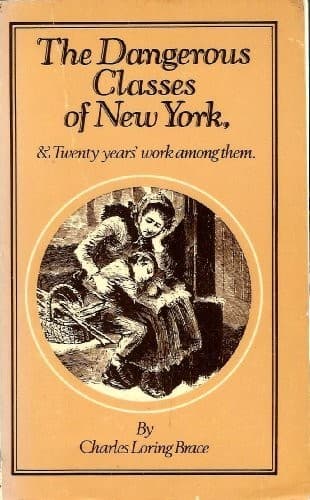
The Dangerous Classes of New York, and Twenty Years' Work Among ThemBrace, Charles Loring
History
The Dangerous Classes of New York, and Twenty Years' Work Among Them
Brace, Charles Loring
Child welfare -- New York (State) -- New York; New York (N.Y.) -- Social conditions; Poor -- New York (State) -- New York
With a small number of the better classes there was also a determined
opposition to this humane remedy. What may be called the
"Asylum-interest" set itself in stiff repugnance to our
emigration-scheme. They claimed--and I presume the most obstinate among
them still claim--that we were scattering poison over the country, and
that we benefited neither the farmers nor the children. They urged that
a restraint of a few years in an Asylum or House of Detention rendered
these children of poverty much more fit for practical life, and purified
them to be good members of society.
We, on the other hand, took the ground that, as our children were not
criminals, but simply destitute and homeless boys and girls, usually
with some ostensible occupation, they could not easily, on any legal
grounds, be inclosed within Asylums; that, if they were, the expense of
their maintenance would be enormous, while the cost of a temporary care
of them in our Schools and Lodging-houses, and their transferrence to
the West, was only trifling--in the proportion of fifteen dollars to one
hundred and fifty dollars, reckoning the latter as a year's cost for a
child's support in an Asylum. Furthermore, we held and stoutly
maintained that an asylum-life is a bad preparation for practical life.
The child, most of all, needs individual care and sympathy. In an
Asylum, he is "Letter B, of Class 3," or "No. 2, of Cell 426," and that
is all that is known of him. As a poor boy, who most live in a small
house, he ought to learn to draw his own water, to split his wood,
kindle his fires, and light his candle; as an "institutional child," he
is lighted, warmed, and watered by machinery. He has a child's
imitation, a desire to please his superiors, and readiness to be
influenced by his companions. In a great caravansary he soon learns the
external virtues which secure him a good bed and meal--decorum and
apparent piety and discipline--while he practices the vices and
unnamable habits which masses of boys of any class nearly always teach
one another. His virtue seems to have an alms-house flavor; even his
vices do not present the frank character of a thorough street-boy; he is
found to lie easily, and to be very weak under temptation; somewhat
given to hypocrisy, and something of a sneak. And, what is very natural,
_the longer he is in the Asylum, the less likely he is to do well in
outside life._ I hope I do no injustice to the unfortunate graduates of
our Asylums; but that was and continues to be my strong impression of
the institutional effect on an ordinary street boy or girl. Of course
there are numerous exceptional cases among children--of criminality and
inherited habits, and perverse and low organization, and premature
cunning, lust, and temper, where a half-prison life may be the very best
thing for them; but the majority of criminals among children, I do not
believe, are much worse than the children of the same class outside, and
therefore need scarcely any different training.
Public-domain text, read in full here on John Shaqi.
Reviews
Reviews
No reviews yet
Be the first to share your thoughts on this work.
Elsewhere in the archive
Join the Discussion
Join the discussion
Sign in to leave a comment or review.
Sign InorCreate an account