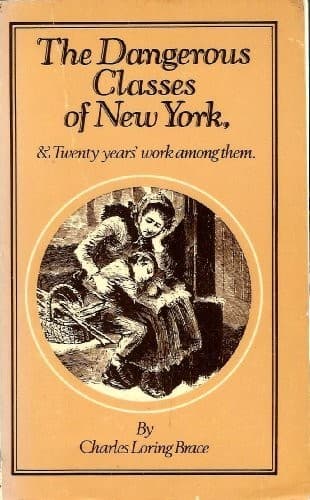
The Dangerous Classes of New York, and Twenty Years' Work Among ThemBrace, Charles Loring
History
The Dangerous Classes of New York, and Twenty Years' Work Among Them
Brace, Charles Loring
Child welfare -- New York (State) -- New York; New York (N.Y.) -- Social conditions; Poor -- New York (State) -- New York
"The former estimate is nearly the same as one forwarded to us since by
an intelligent clergyman of Michigan (Rev. Mr. Gelston, of Albion), of
the result in his State. Of course, some of the older boys disappear
entirely; some few return to the city; but it may generally be assumed
that we hear of the worst cases--that is, of those who commit criminal
offenses, or who come under the law--and it is these whom we reckon as
the failures. One or two of such cases, out of hundreds in a given
district who are doing well, sometimes make a great noise, and give a
momentary impression that the work is not coming out well there; and
there are always a few weak-minded people who accept such rumors without
examination. Were the proportion of failures far greater than it is, the
work would still be of advantage to the West, and a rich blessing to the
city.
"It is also remarkable, as years pass away, how few cases ever come to
the knowledge of the Society, of ill-treatment of these children. The
task of distributing them is carried on so publicly by Mr. Tracy, and in
connection with such responsible persons, that any case of positive
abuse would at once be known and corrected by the community itself.
"'On this journey,' says the secretary, 'we heard of but one instance
even of neglect. We visited the lad, and discovered that he had not been
schooled as he should, and had sometimes been left alone at night in the
lonely log-house. Yet this had roused the feelings of the whole
country-side; we removed the boy, amid the tears and protestations of
the "father" and "mother," and put him in another place. As soon as we
had left the village, he ran right back to his old place!'
* * * * * * *
"We give our evidence below, consisting of letters from prominent
gentlemen, clergymen, bankers, farmers, judges, and lawyers, through the
West, where the main body of these poor children have been placed. We
think these letters, coming from some hundred different towns, and the
evidence on our books from the boys themselves, establish the remarkable
success of the work. Some of the writers speak of the children as
thriving 'as well as any other children;' and, in some cases, those who
have become disobedient and troublesome are said to have been so
principally through the fault of their employers; few instances,
comparatively, from this four or five thousand, are known to have
committed criminal offenses--in some States not more than four per cent.
This is true of Michigan; and in Ohio, we do not think, from all the
returns we can gather, that the proportion is even so large as that. The
agent of the American and Foreign Christian Union for Indiana, a
gentleman of the highest respectability, constantly traveling through
the State--a State where we have placed five hundred and fifty-seven
children--testifies that 'very few have gone back to New York,' and that
'he has heard of no one who has committed criminal offenses.'
Public-domain text, read in full here on John Shaqi.
Reviews
Reviews
No reviews yet
Be the first to share your thoughts on this work.
Elsewhere in the archive
Join the Discussion
Join the discussion
Sign in to leave a comment or review.
Sign InorCreate an account