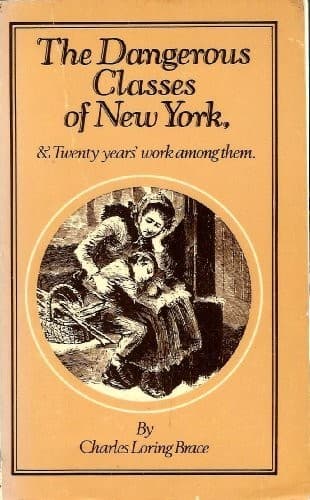
The Dangerous Classes of New York, and Twenty Years' Work Among ThemBrace, Charles Loring
History
The Dangerous Classes of New York, and Twenty Years' Work Among Them
Brace, Charles Loring
Child welfare -- New York (State) -- New York; New York (N.Y.) -- Social conditions; Poor -- New York (State) -- New York
"The superintendent of the Chicago Reform School, one of the most
successful and experienced men in this country in juvenile reform,
states that his institution had never had but three of our children
committed by the Illinois State Courts, though we have sent to the State
two hundred and sixty-five, and such an institution is, of course, the
place where criminal children of this class would at once be committed.
"A prominent gentleman residing in Battle Creek, Michigan, in the
neighborhood of which we have put out about one hundred and twenty,
writes: 'I think it is susceptible of proof that no equal number of
children raised here are superior to those you have placed out.' Two
prominent gentlemen from Pennsylvania, one of them a leading judge in
the State, write that they have not known an instance of one of our
children being imprisoned for a criminal offense, though we have sent
four hundred and sixty-nine to this State."
These important results were obtained in 1859, with but four or five
thousand children settled in the West. We have now in various portions
of our country _between twenty and twenty-four thousand_ who have been
placed in homes or provided with work.
The general results are similar. The boys and girls who were sent out
when under fourteen are often heard from, and succeed remarkably well.
In hundreds of instances, they cannot be distinguished from the young
men and women natives in the villages. Large numbers have farms of their
own, and are prospering reasonably well in the world. Some are in the
professions, some are mechanics or shopkeepers; the girls are generally
well married. Quite a number have sent donations to the Society, and
some have again in their turn brought up poor children. It was estimated
that more than a thousand were in the national army in the civil war.
With them the experiment of "Emigration" has been an unmingled blessing.
With the larger boys, as we stated before, exact results are more
difficult to attain, as they leave their places frequently. Some few
seem to drift into the Western cities, and take up street-trades again.
Very few, indeed, get back to New York. The great mass become honest
producers on the Western soil instead of burdens or pests here, and are
absorbed into that active, busy population; not probably becoming
saints-on-earth, but not certainly preying on the community, or living
idlers on the alms of the public. Many we know who have also led out
their whole family from the house of poverty here, and have made the
last years of an old father or mother easier and more comfortable.
[Illustration: THE STREET BOY ON A FARM. (A year later.) NO. 2.]
Public-domain text, read in full here on John Shaqi.
Reviews
Reviews
No reviews yet
Be the first to share your thoughts on this work.
Elsewhere in the archive
Join the Discussion
Join the discussion
Sign in to leave a comment or review.
Sign InorCreate an account