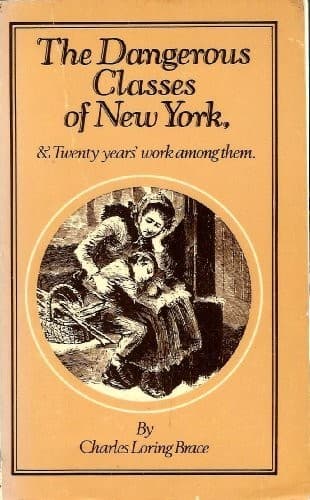
The Dangerous Classes of New York, and Twenty Years' Work Among ThemBrace, Charles Loring
History
The Dangerous Classes of New York, and Twenty Years' Work Among Them
Brace, Charles Loring
Child welfare -- New York (State) -- New York; New York (N.Y.) -- Social conditions; Poor -- New York (State) -- New York
The Reading-rooms connected with Boys' Lodging-houses, though sometimes
doing well, are not uniformly successful, perhaps from the fact that
workingmen do not like to be associated with homeless boys.
Besides those connected with the Children's Aid Society, the City
Mission and various churches have founded others, so that now the Free
Reading-room is recognized as one of the means for improving the
"dangerous classes," as much as the Sunday School, Chapel, or Mission.
The true theory of the formation of the Reading-room is undoubtedly the
inducing the laboring class to engage in the matter themselves, and then
to assist them in meeting the expenses. But the lowest poor and the
young men who frequent the grog-shops are so indifferent to mental
improvement, and so seldom associate themselves for any virtuous object,
that it is extremely difficult to induce them to combine for this.
Moreover, as they rise in the social scale, they find organizations
ready to hand, like the "Cooper Union," where Reading-rooms and
Libraries are provided gratuitously. For the present, the Reading-room
may be looked upon, like the Public School, as a means of improvement
offered by society, in its own Interest, to all.
CHAPTER XXV.
HOMELESS GIRLS.
It was a fortunate event for our charity which led, in 1861, a certain
New York merchant to accept the position of President of our Society.
Mr. William A. Booth had the rare combination of qualities which form a
thorough presiding officer, and at the same time he was inspired by a
spirit of consecration to what he believed his Master's service, rarely
seen among men. His faculty of "rolling off" business, of keeping his
assembly or board on the points before them--for even business men have
sometimes the female tendency of rather wide-reaching discussions and
conversations--his wonderful clearness of comprehension, and a judicial
faculty which nearly always enabled him to balance with remarkable
fairness both sides of a question, made him beyond comparison the best
presiding officer for a business-board I have ever seen. With him, we
always had short and very full sessions, and reached our points rapidly
and efficiently. He had, too, the capacity, rare among men of organizing
brains, of accepting a rejection or rebuff to any proposition he may
have made (though this happened seldom) with perfect good humor. Perhaps
more than with his public services in our Board, I was struck with his
private career. Hour after hour in his little office, I have seen
different committees and officials of numerous societies, charities, and
financial associations come to him with their knotty points, and watched
with admiration as he disentangled each question, seeming always to
strike upon the course at once wise and just. A very small portion of
his busy time was then given to his own interests, though he had been
singularly successful in his private affairs.
Public-domain text, read in full here on John Shaqi.
Reviews
Reviews
No reviews yet
Be the first to share your thoughts on this work.
Elsewhere in the archive
Join the Discussion
Join the discussion
Sign in to leave a comment or review.
Sign InorCreate an account