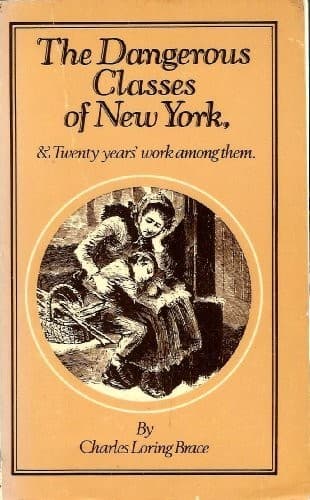
The Dangerous Classes of New York, and Twenty Years' Work Among ThemBrace, Charles Loring
History
The Dangerous Classes of New York, and Twenty Years' Work Among Them
Brace, Charles Loring
Child welfare -- New York (State) -- New York; New York (N.Y.) -- Social conditions; Poor -- New York (State) -- New York
He seemed to me to carry
out wonderfully the Christian ideal in practical life in a busy city;
living day after day "for others," and to do the will of Him whom he
followed.
In our first labors together, I feared that, owing to his stricter
school of Presbyterian theology, we might not agree in some of our aims
and plans; but the practical test of true benefit to these unfortunate
children soon brought our theoretic views to a harmony in religious
practice; and as we both held that the first and best of all truths to
an outcast boy is the belief and love of Christ as a friend and Saviour,
we agreed on the substantial matter. I came, year by year, greatly to
value his judgment and his clear insight as to the _via media._
Both with him and our Treasurer, Mr. Williams, the services of love
rendered so many years to this cause of humanity, could not, as mere
labor, have been purchased with very lucrative salaries.
Mr. Booth's wise policy with the Society was to encourage whatever would
give it a more permanent foot-hold in the city, and, in this view, to
stimulate especially the founding of our Lodging-houses by means of
"funds," or by purchasing buildings.
How this plan succeeded, I shall detail hereafter.
At this present stage in our history, his attention was especially fixed
on the miserable condition of the young street-girls, and he suggested
to me what I had long been hoping for, the formation of a Lodging-house
for them, corresponding to that which had been so successful with the
newsboys.
As a preparatory step, I consulted carefully the police. They were
sufficiently definite as to the evil, but not very hopeful as to the
cure.
THE STREET-GIRLS.
I can truly say that no class we have ever labored for seemed to combine
so many elements of human misfortune and to present so many discouraging
features as this. They form, indeed, a class by themselves.
[Illustration: THE HOMELESS.]
Their histories are as various as are the different lots of the
inhabitants of a populous town. Some have come from the country, from
kind and respectable homes, to seek work in the city; here they
gradually consume their scanty means, and are driven from one refuge to
another, till they stand on the street, with the gayly-lighted house of
vice and the gloomy police-station to choose between. Others have sought
amusement in the town, and have been finally induced to enter some house
of bad character as a boarding-house, and have been thus entrapped; and
finally, in despair, and cursed with disease, they break loose, and take
shelter even in the prison-cell, if necessary. Others still have
abandoned an ill-tempered step-mother or father, and rushed out on the
streets to find a refuge, or get employment anywhere.
Public-domain text, read in full here on John Shaqi.
Reviews
Reviews
No reviews yet
Be the first to share your thoughts on this work.
Elsewhere in the archive
Join the Discussion
Join the discussion
Sign in to leave a comment or review.
Sign InorCreate an account