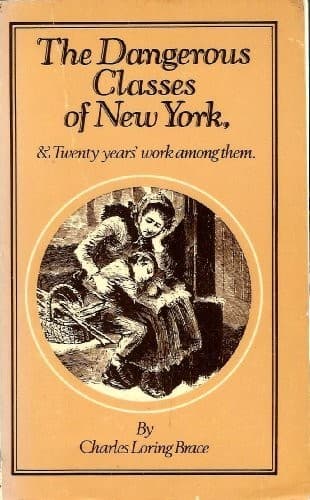
The Dangerous Classes of New York, and Twenty Years' Work Among ThemBrace, Charles Loring
History
The Dangerous Classes of New York, and Twenty Years' Work Among Them
Brace, Charles Loring
Child welfare -- New York (State) -- New York; New York (N.Y.) -- Social conditions; Poor -- New York (State) -- New York
It soon turned out, however, that the young street-children who were
engaged in street-trades, had some relative to whom their labor was of
profit, so that they gradually drifted back to their cellars and attics,
and only occasionally took a night's lodging when out late near the
theatre. Those who were the greatest frequenters of the House proved to
be the young girls between fourteen and eighteen.
And a more difficult class than these to manage, no philanthropic mortal
ever came in contact with. The most had a constitutional objection to
work; they had learned to do nothing well, and therefore got but little
wages anywhere; they were shockingly careless, both of their persons and
their clothing; and, worse than all, they showed a cunning and skill of
deceit and a capacity of scandal, and of setting the family by the ears
in petty quarrels and jealousies, which might have discouraged the most
sanguine reformer.
The matron, Mrs. Trott, who had especially to struggle with these evils,
had received a fitting preparatory training: she had taught in the "Five
Points." She was a thorough disciplinarian; believed in work, and was
animated by the highest Christian earnestness.
As years passed by, the only defect that appeared in her was, perhaps,
what was perfectly natural in such circumstances. The sins of the world,
and the calamities of the poor, began to weigh on her mind, until its
spring was fairly bent. Society seemed to her diseased with the sin
against purity. The outcast daughters of the poor had no chance in this
hard world. All the circumstances of life were against the friendless
girl. Often, after most self-denying, and, to other minds, successful
efforts to benefit these poor creatures, some enthusiastic spectator
would say, "How much good you are doing!" "Well," she would say, with a
sigh, "I sometimes hope so!"
Once, I asked her if she could not write a cheerful report for our
trustees, giving some of the many encouraging facts she knew.
To my dismay, when the document appeared, the first two pages were
devoted to a melancholy recollection of the horrible typhus which had
once desolated the household! I think, finally, her mind took almost a
sad pleasure in dwelling on the woes and miseries of humanity. Still,
even with this constitutional weight on her, she did her work for those
unfortunate girls faithfully and devotedly.
Public-domain text, read in full here on John Shaqi.
Reviews
Reviews
No reviews yet
Be the first to share your thoughts on this work.
Elsewhere in the archive
Join the Discussion
Join the discussion
Sign in to leave a comment or review.
Sign InorCreate an account