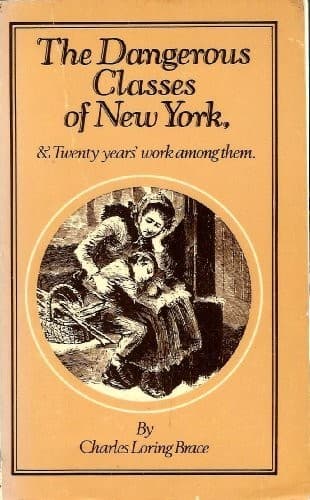
The Dangerous Classes of New York, and Twenty Years' Work Among ThemBrace, Charles Loring
History
The Dangerous Classes of New York, and Twenty Years' Work Among Them
Brace, Charles Loring
Child welfare -- New York (State) -- New York; New York (N.Y.) -- Social conditions; Poor -- New York (State) -- New York
The great danger and temptation of such establishments, as I have always
found, are in the desire of keeping the inmates, and showing to the
public your "reforms." My instruction always was, that the "Girls'
Lodging-house" was not to be a "Home." We did not want to make an asylum
of it. We hoped to begin the work of improvement with these young girls,
and then leave them to the natural agencies of society. To teach them to
work, to be clean, and to understand the virtues of order and
punctuality; to lay the foundations of a housekeeper or servant; to
bring the influences of discipline, of kindness, and religion to bear on
these wild and ungoverned creatures--these were to be the great objects
of the "Lodging-house;" then some good home or respectable family were
to do the rest. We were to keep lodgers a little while only, and then to
pass them along to situations or places of work.
The struggles of Mr. and Mrs. Trott, the superintendent and matron,
against these discouraging evils in the condition and character of this
class, would make a history in itself! They set themselves to work upon
details, with an abounding patience, and with a humanity which was not
to be wearied.
The first effort was to teach the girls something like a habit of
personal cleanliness; then, to enforce order and punctuality, of which
they knew nothing; next, to require early rising, and going to bed at a
reasonable hour. The lessons of housekeeping were begun at the
foundation, being tasks in scrubbing and cleaning; then, bed-making, and
finally plain cooking, sewing, and machine-work. Some of the inmates
went out for their daily labor in shops or factories; but the most had
to be employed in house-work, and thus paid for their support. They soon
carried on the work of a large establishment, and at the same time made
thousands of articles of clothing for the poor children elsewhere under
the charge of the Society.
A great deal of stress, of course, was laid on religious and moral
instruction. The girls always "listened gladly," and were easily moved
by earnest and sympathetic teaching and oratory.
Fortunately for the success of this Charity, one of our trustees, a man
filled with "the milk of human kindness," Mr. B. J. Howland, took part
in it, as if it were his main occupation in life. Twice in the week, he
was present with these poor girls for many years, teaching them the
principles of morality and religion, training them in singing,
contriving amusements and festivals for them, sympathizing in their
sorrows and troubles, until he became like a father and counselor to
these wild, heedless young creatures.
When, at length, the good old man departs--_et serus in coelum
redeat!_--the tears of the friendless and forgotten will fall on his
grave,
"And the blessings of the poor
Shall waft him to the other shore."
Public-domain text, read in full here on John Shaqi.
Reviews
Reviews
No reviews yet
Be the first to share your thoughts on this work.
Elsewhere in the archive
Join the Discussion
Join the discussion
Sign in to leave a comment or review.
Sign InorCreate an account