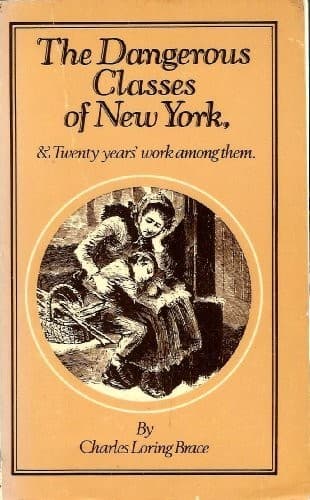
The Dangerous Classes of New York, and Twenty Years' Work Among ThemBrace, Charles Loring
History
The Dangerous Classes of New York, and Twenty Years' Work Among Them
Brace, Charles Loring
Child welfare -- New York (State) -- New York; New York (N.Y.) -- Social conditions; Poor -- New York (State) -- New York
Our books give hundreds of similar stories, where a free country-life
and the amusements and sports of the farmers, when work is slack, have
gratified healthfully the vagrant appetite. The mere riding a horse, or
owning a calf or a lamb, or trapping an animal in winter, seems to have
an astonishing effect in cooling the fire in the blood in the city
rover, and making him contented.
The social habits of the army of little street-vagrants who rove through
our city have something unaccountable and mysterious in them. We have,
as I have described, in various parts of the city little "Stations," as
it were, in their weary journey of life, where we ostensibly try to
refresh them, but where we really hope to break up their service in the
army of vagrancy, and make honest lads of them. These "Lodging-houses"
are contrived, after much experience, so ingeniously that they
inevitably attract in the young vagabonds, and drain the quarter where
they are placed of this class. We give the boys, in point of fact, more
for their money than they can get anywhere else, and the whole house is
made attractive and comfortable for them. But the reasons of their
coming to a given place seem unaccountable.
Thus there will be a "Lodge" in some out-of-the-way quarter, with no
special attractions, which for years will drag along with a
comparatively small number of lodgers, when suddenly, without any change
being made, there will come a rush of street-rovers to it, and scores
will have to be sent away, and the house be crowded for months after.
Perhaps these denizens of boxes and hay-barges have their own fashions,
like their elders, and a "Boys' Hotel" becomes popular, and has a run of
custom like the larger houses of entertainment. The numbers too, at
different seasons, vary singularly. Thus, in the coldest nights of
winter, when few boys could venture to sleep out, and one would suppose
there would be a rush to these warmed and comfortable "Lodges," the
attendance in some houses falls off. And in all, the best months are the
spring and autumn rather than the winter or summer. Sometimes a single
night of the week will show a remarkable increase of lodgers, though for
what reason no one can divine.
The lodgers in the different houses are singularly different. Those in
the parent Lodging-house--the Newsboys'--seem more of the true _gamin_
order: sharp, ready, light-hearted, quick to understand and quick to
act, generous and impulsive, and with an air of being well used "to
steer their own canoe" through whatever rapids and whirlpools. These
lads seem to include more, also, of that chance medley of little
wanderers who drift into the city from the country, and other large
towns--boys floating on the current, no one knows whence or whither.
They are, as a rule, younger than in the other "Lodges," and many of
them are induced to take places on farms, or with mechanics in the
country.
Public-domain text, read in full here on John Shaqi.
Reviews
Reviews
No reviews yet
Be the first to share your thoughts on this work.
Elsewhere in the archive
Join the Discussion
Join the discussion
Sign in to leave a comment or review.
Sign InorCreate an account