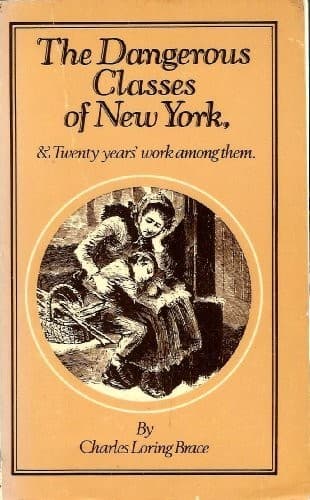
The Dangerous Classes of New York, and Twenty Years' Work Among ThemBrace, Charles Loring
History
The Dangerous Classes of New York, and Twenty Years' Work Among Them
Brace, Charles Loring
Child welfare -- New York (State) -- New York; New York (N.Y.) -- Social conditions; Poor -- New York (State) -- New York
One of the mysterious things about this Boys' Hotel is, what becomes of
the large numbers that enter it? In the course of the twelve months
there passes through its hospitable doors a procession of more than
_eight thousand_ different youthful rovers of the streets--boys without
homes or friends; yet, on any one night, there is not an average of more
than two hundred. Each separate boy accordingly averages but nine days
in his stay. We can trace during the year the course of, perhaps, a
thousand of these young vagrants, for most of whom we provide ourselves.
What becomes of the other seven thousand? Many, no doubt, find
occupation in the city or country; some in the pleasant seasons take
their pleasure and business at the watering-places and other large
towns; some return to relatives or friends; many are arrested and
imprisoned, and the rest of the ragged throng drift away, no one knows
whither.
The up-town Lodging-houses seem often to gather in a more permanent
class of lodgers; they become frequently genuine boarding-houses for
children. The lads seem to be, too, a more destitute and perhaps lower
class than "the down-town boys." Possibly by a process of "Natural
Selection," only the sharpest and brightest lads get through the intense
"struggle for existence" which belongs to the most crowded portions of
the city, while the duller are driven to the up-town wards. We throw out
the hypothesis for some future investigator.
The great amusement of this multitude of street vagabonds is the cheap
theatre. Like most boys, they have a passion for the drama. But to them
the pictures of kings and queens, the processions of courtiers and
soldiers on the stage, and the wealthy gentlemen aiding and rescuing
distressed peasant-girls, are the only glimpses they ever get of the
great world of history and society above them, and they are naturally
entranced by them. Many a lad will pass a night in a box, and spend his
last sixpence, rather than lose this show. Unfortunately, these low
theatres seem the rendezvous for all disreputable characters; and here
the "bummers" make the acquaintance of the higher class whom they so
much admire, of "flashmen," thieves, pickpockets, and rogues.
We have taken the pains at different times to see some of the pieces
represented in these places, and have never witnessed anything improper
or immoral. On the contrary, the popular plays were always of a heroic
and moral cast. "Uncle Tom," when it was played in the Bowery,
undoubtedly had a good moral and political effect, in the years before
the war, on these ragamuffins.
Public-domain text, read in full here on John Shaqi.
Reviews
Reviews
No reviews yet
Be the first to share your thoughts on this work.
Elsewhere in the archive
Join the Discussion
Join the discussion
Sign in to leave a comment or review.
Sign InorCreate an account