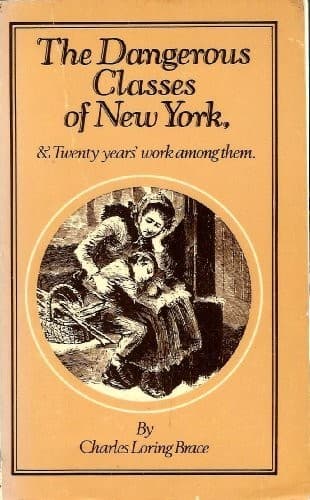
The Dangerous Classes of New York, and Twenty Years' Work Among ThemBrace, Charles Loring
History
The Dangerous Classes of New York, and Twenty Years' Work Among Them
Brace, Charles Loring
Child welfare -- New York (State) -- New York; New York (N.Y.) -- Social conditions; Poor -- New York (State) -- New York
The steady labor, punctuality, and order of a good school, the high tone
in many of our Free Schools, the self-respect cultivated, the emulation
aroused, the love of industry thus planted, are just the influences to
break up a vagabond, roving, and dependent habit of mind and life. The
School, with the Lodging-house, is the best preventive institution for
vagrancy.
The Massachusetts system of "Truant-schools"--that is, Schools to which
truant officers could send children habitually truant--does not seem so
applicable to New York. The number of "truants" in the city is not very
large; they are in exceedingly remote quarters, and it would be very
difficult to collect them in any single School.
Our "Industrial Schools" seem to take their place very efficiently. The
present truant-officers of the city are active and judicious, and return
many children to the Schools.
COMPULSORY EDUCATION.
The best general law on this subject, both for country and city, would
undoubtedly be, a law for compulsory education, allowing "Half-time
Schools" to children requiring to be employed a part of the day.
There is no doubt that the time has arrived for the introduction of such
laws throughout the country. During the first years of the national
existence, and especially in New England and the States peopled from
that region, there was so strong an impression among the common people,
of the immense importance of a system of free instruction for all, that
no laws or regulations were necessary to enforce it. Our ancestors were
only too eager to secure mental training for themselves, and
opportunities of education for their children. The public property in
lands was, in many States, early set aside for purposes of school and
college education; and the poorest farmers and laboring people often
succeeded in obtaining for their families and descendants the best
intellectual training which the country could then bestow.
But all this, in New England and other portions of the country, has
greatly changed. Owing to foreign immigration and to unequal
distribution of wealth, large numbers of people have grown up without
the rudiments even of common-school education. Thus, according to the
report of 1871, of the National Commissioners of Education, there are in
the New England States 195,963 persons over ten years of age who cannot
write, and, therefore, are classed as "illiterates." In New York State
the number reaches the astounding height of 241,152, of whom 10,639 are
of the colored race. In Pennsylvania the number is 222,356; in Ohio,
173,172, and throughout the Union the population of the illiterates sums
up the fearful amount of 5,660,074 In New York State the number of
illiterate minors between ten and twenty-one years amounts to 42,405. In
this city there are 62,238 persons over ten who cannot write, of whom
53,791 are of foreign birth. Of minors between ten and twenty-one, there
are here 8,017 illiterates.
Public-domain text, read in full here on John Shaqi.
Reviews
Reviews
No reviews yet
Be the first to share your thoughts on this work.
Elsewhere in the archive
Join the Discussion
Join the discussion
Sign in to leave a comment or review.
Sign InorCreate an account