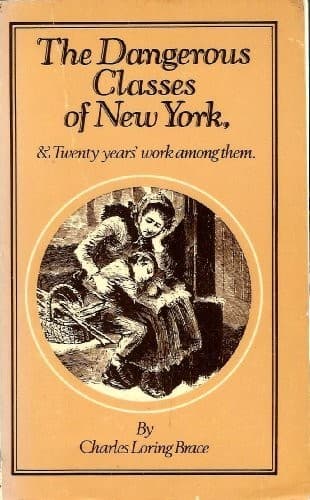
The Dangerous Classes of New York, and Twenty Years' Work Among ThemBrace, Charles Loring
History
The Dangerous Classes of New York, and Twenty Years' Work Among Them
Brace, Charles Loring
Child welfare -- New York (State) -- New York; New York (N.Y.) -- Social conditions; Poor -- New York (State) -- New York
The salvation of New York, as regards this army of young vagabonds, is,
without doubt, its climate. There can be no permanent class of lazzaroni
under our winters. The cold compels work. The snow drives "the
street-rats," as the police call them, from their holes. Then the
homeless boys seek employment and a shelter. And when they are once
brought under the series of moral and physical instrumentalities
contrived for their benefit, they cease soon to be vagrants, and join
the great class of workers and honest producers.
A CORRECTIVE.
One of the best practical methods of correcting vagrancy among city boys
would be the adoption, by every large town, of an "ordinance" similar to
that passed by the Common Council of Boston.
By this Act, every child who pursues any kind of street-trade for an
occupation--such as news-vending, peddling, blackening of boots, and the
like--is obliged to procure a license, which must be renewed every three
months. If he is found at any time without this license, he is liable to
summary arrest as a vagrant. To procure the license, each child must
show a certificate that he has been, or is, attending some school,
whether public, or industrial, or parish, during three hours each day.
The great advantage of a law of this nature, is, that it can be
executed. Any ordinary legislation against youthful vagrants--such as
arresting any child found in the streets during school-hours, or without
occupation--is sure to become ineffectual through the humanity and
good-nature of officials and judges. Moreover, every young rover of the
streets can easily trump up some occupation, which he professes to
follow.
Thus, now, as is well known, most of the begging children in New York
are apparently engaged in selling "black-headed pins," or some other
cheap trifle.
They can almost always pretend some occupation--if it be only sweeping
sidewalks--which enables them to elude the law. Nor can we reasonably
expect a judge to sentence a child for vagrancy, when it claims to be
supporting a destitute parent by earnings in a street-trade, though the
occupation may be a semi-vagrant one, and may lead inevitably to
idleness and crime. Nor does the action of a truant-officer prevent the
necessity of such a law, because this official only acts on the truant
class of children, not on those who attend no school whatever. By an
ordinance like this of Boston, every child can be forced to at least
three hours' schooling each day; and, as any school is permitted, no
sectarian or bigoted feeling is aroused by this injunction.
The police would be more ready to arrest, and the Judges to sentence,
the violators of so simple and rational a law. The wanderers of the
street would then be brought under legal supervision, which would not be
too harsh or severe. Education may not, in all cases, prevent crime; yet
we well know that, on a broad scale, it has a wonderful effect in
checking it.
Public-domain text, read in full here on John Shaqi.
Reviews
Reviews
No reviews yet
Be the first to share your thoughts on this work.
Elsewhere in the archive
Join the Discussion
Join the discussion
Sign in to leave a comment or review.
Sign InorCreate an account