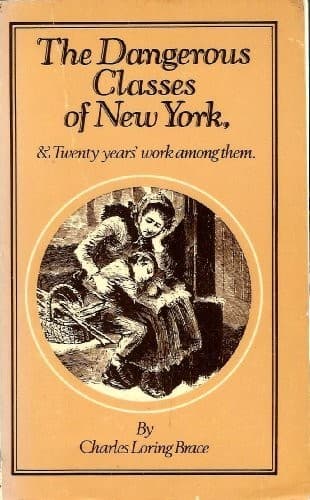
The Dangerous Classes of New York, and Twenty Years' Work Among ThemBrace, Charles Loring
History
The Dangerous Classes of New York, and Twenty Years' Work Among Them
Brace, Charles Loring
Child welfare -- New York (State) -- New York; New York (N.Y.) -- Social conditions; Poor -- New York (State) -- New York
The report of the Deputy State Comptroller, Gen. Oliver, shows certain
defects in the phraseology of the act, and various difficulties in its
execution, but no more than might naturally be expected in such
legislation. Thus, there is not sufficient power conferred on the
executive officer to enter manufacturing establishments, or to secure
satisfactory evidence of the law having been violated; and no sufficient
certificates or forms of registration of the age and school attendance
of factory children are provided for. The act, too, it is claimed, is
not sufficiently yielding, and therefore may bear severely in certain
cases on the poor.
The reports, however, from this officer, and from the Boston "Bureau of
Labor," show how much is already being accomplished in Massachusetts to
bring public attention to bear on the subject. Laws often act as
favorably by indirect means as by direct. They arouse conscience and
awaken consideration, even if they cannot be fully executed. As a class,
New England manufacturers are exceedingly intelligent and
public-spirited, and when their attention was called to this growing
evil by the law, they at once set about efforts to remedy it. Many of
them have established "half-time schools," which they require their
young _employes_ to attend; and they find their own interests advanced
by this, as they get a better class of laborers. Others arrange "double
gangs" of young workers, so that one-half may take the place of the
other in the mill, while the former are in school. Others have founded
"Night-schools." There is no question that the law, with all its
defects, has already served to lessen the evil.
RHODE ISLAND LEGISLATION.
The Rhode Island act (chapter 139) does not differ materially from that
of Massachusetts, except that twelve years is made the minimum age at
which a child can be employed in factories; and children, even during
the nine months of factory work every year, are not allowed to be
employed more than eleven hours per day. The penalty is made but twenty
dollars, which can be recovered before any Justice of the Peace, and
one-half is to go to the complainant and the other to the District or
Public School.
CONNECTICUT LEGISLATION.
In matters of educational reform Connecticut is always the leading State
of the Union. On this subject of children's overwork, and consequent
want of education, she has legislated since 1842.
Public-domain text, read in full here on John Shaqi.
Reviews
Reviews
No reviews yet
Be the first to share your thoughts on this work.
Elsewhere in the archive
Join the Discussion
Join the discussion
Sign in to leave a comment or review.
Sign InorCreate an account