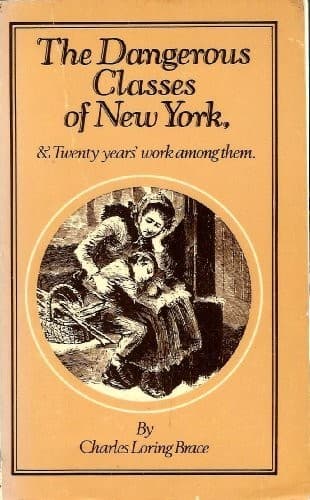
The Dangerous Classes of New York, and Twenty Years' Work Among ThemBrace, Charles Loring
History
The Dangerous Classes of New York, and Twenty Years' Work Among Them
Brace, Charles Loring
Child welfare -- New York (State) -- New York; New York (N.Y.) -- Social conditions; Poor -- New York (State) -- New York
The original act, however, was strengthened and, in part, repealed by
another law passed in July, 1869 (chapter 115), which is the most
stringent act on this subject in the American code. In all the other
legislation the law is made to apply solely to manufacturers and
mechanics; in this it includes all employment of children, the State
rightly concluding that it is as much against the public weal to have a
child grow up ignorant and overworked with a farmer as with a
manufacturer. The Connecticut act, too, leaves out the word "knowingly,"
with regard to the employer's action in working the child at too tender
years, or beyond the legal time. It throws on the employer the
responsibility of ascertaining whether the children employed have
attended school the required time, or whether they are too young for his
labor. Nor is it enough that the child should have been a member of a
school for three months; his name must appear on the register for sixty
days of actual attendance.
The age under which three months' school-time is required is fourteen.
The penalty for each offense is made one hundred dollars to the
Treasurer of the State. Four different classes of officers are
instructed and authorized to co-operate with the State in securing every
child under fourteen three months of education, and in protecting him
from overwork, namely, School-Visitors, the Board of Education, State
Attorneys, and Grand Jurors. The State Board of Education is "authorized
to take such action as may be deemed necessary to secure the enforcement
of this act, and may appoint an agent for that purpose."
The defects of the law seem to be that it provides for no minimum of age
in which a child may be employed in a factory, and does not limit the
number of hours of labor per week for children in manufacturing
establishments. Neither of these limitations is necessary in regard to
farm-labor.
The agent for executing the law in Connecticut, Mr. H. M. Cleaveland,
seems to have acted with great wisdom, and to have secured the hearty
co-operation of the manufacturers. "Three-fourths of the manufacturers
of the State," he says, "of almost everything, from a needle up to a
locomotive, were visited, and pledged themselves to a written
agreement," that they would employ no children under fourteen years of
age, except those with certificates from the local school-officers of
actual school attendance for at least three months.
This fact alone reflects the greatest credit on this intelligent class.
And we are not surprised that they are quoted as saying, "We do not dare
to permit the children within and around our mills to grow up without
some education. Better for us to pay the school expenses ourselves than
have the children in ignorance."
Public-domain text, read in full here on John Shaqi.
Reviews
Reviews
No reviews yet
Be the first to share your thoughts on this work.
Elsewhere in the archive
Join the Discussion
Join the discussion
Sign in to leave a comment or review.
Sign InorCreate an account