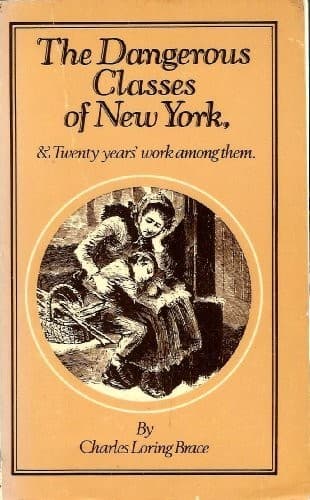
The Dangerous Classes of New York, and Twenty Years' Work Among ThemBrace, Charles Loring
History
The Dangerous Classes of New York, and Twenty Years' Work Among Them
Brace, Charles Loring
Child welfare -- New York (State) -- New York; New York (N.Y.) -- Social conditions; Poor -- New York (State) -- New York
An important question often comes up in regard to our charitable
associations: "How shall they best be supported?"--by endowment from the
State or by private and annual assistance? There is clearly a right that
all charities of a general nature should expect some help from the
public Legislature. The State is the source of the charters of all
corporations. One of the main duties of a Legislature is to care for the
interests of the poor and criminal. The English system, dating as far
back as Henry VIII, has been to leave the charge of the poor and all
educational institutions, as much as possible, to counties or local
bodies or individuals. It has been, so far as the charge of the poor is
concerned, imitated here. But in neither country has it worked, well;
and the last relic of it will probably soon be removed in this State, by
placing the defective persons--the blind and dumb, and insane and idiot,
and the orphans--in the several counties in State institutions. The
charge of criminals and reformatory institutions are also largely placed
under State control and supervision.
The object of a State Legislature in all these matters is _bonum
publicum_--the public weal. If they think that a private charity is
accomplishing a public work of great value, which is not and perhaps
cannot be accomplished by purely public institutions, they apparently
have the same right to tax the whole community, or a local community,
for its benefit, that they have now to tax it for the support of
schools, or Almshouses, or Prisons, or Houses of Refuge. In such a case
it need not be a matter of question with the Legislature whether the
charity is "sectarian" or not; whether it teaches Roman Catholicism, or
Protestantism, or the Jewish faith, or no faith. The only question with
the governing power is, "Does it do a work of public value not done by
public institutions?" If it does; if for instance, it is a
Roman-Catholic Reformatory, or a Protestant House of Refuge, or
Children's Aid Society, the Legislature, knowing that all public and
private organizations together cannot fully remedy the tremendous evils
arising from a class of neglected and homeless children, is perfectly
right in granting aid to such institutions without reference to their
"sectarian" character. It reserves to itself the right of inspection,
secured in this State by our admirable Board of Inspectors of State
Charities; and it can at any time repeal the charters of, or refuse the
appropriations to, these private associations. But thus far, its uniform
practice has been to aid, to a limited degree, private charities of this
nature.
Public-domain text, read in full here on John Shaqi.
Reviews
Reviews
No reviews yet
Be the first to share your thoughts on this work.
Elsewhere in the archive
Join the Discussion
Join the discussion
Sign in to leave a comment or review.
Sign InorCreate an account