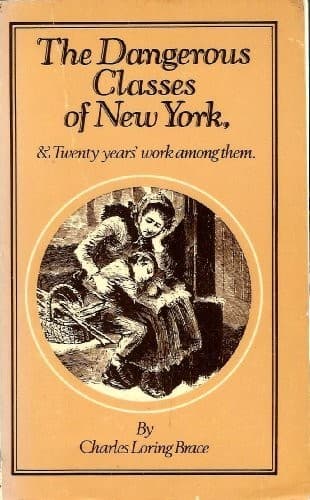
The Dangerous Classes of New York, and Twenty Years' Work Among ThemBrace, Charles Loring
History
The Dangerous Classes of New York, and Twenty Years' Work Among Them
Brace, Charles Loring
Child welfare -- New York (State) -- New York; New York (N.Y.) -- Social conditions; Poor -- New York (State) -- New York
This should by no means be considered a ground for demanding similar
assistance for "sectarian schools." Education is secured now by public
taxation for all; and all can take advantage of it. There is no popular
necessity for Church Schools, and the public good is not promoted by
them as it is by secular schools. Where there are children too poor to
attend the Public Schools, these can be aided by private charitable
associations; and of these, only those should be assisted by the State
which have no sectarian character.
Charities which are entirely supported by State and permanent endowment
are liable, as the experience of England shows, to run into a condition
of routine and lifelessness. The old endowments of Great Britain are
nests of abuses, and many of them are now being swept away. A State
charity has the advantage of greater solidity and more thorough and
expensive machinery, and often more careful organization. But, as
compared with our private charities, the public institutions of
beneficence are dull and lifeless. They have not the individual
enthusiasm working through them, with its ardor and power. They are more
like machines.
On the other hand, charities supported entirely by individuals will
always have but a small scope. The amount of what may be called the
"charity fund" of the community is comparatively limited. In years of
disaster or war, or where other interests absorb the public, it will
dwindle down to a very small sum. It is distributed, too, somewhat
capriciously. Sometimes a "sensation" calls it forth bountifully, while
more real demands are neglected. An important benevolent association,
depending solely on its voluntary contributions from individuals, will
always be weak and incomplete in its machinery. The best course for the
permanency and efficiency of a charity seems to be, to make it depend in
part on the State, that it may have a solid foundation of support, and
be under official supervision, and in part on private aid, so that it
may feel the enthusiasm and activity and responsibility of individual
effort. The "Houses of Refuge" combine public and private assistance in
a manner which has proved very beneficial. Their means come from the
State, while their governing bodies are private, and independent of
politics. The New York "Juvenile Asylum" enjoys both public and private
contributions, but has a private board. On the other hand, the
"Commissioners of Charities and Correction" are supported entirely by
taxation, and, until they had the services of a Board carefully
selected, were peculiarly inefficient. Many private benevolent
associations in the city could be mentioned which have no solid
foundation of public support and are under no public supervision, and,
in consequence, are weak and slipshod in all their enterprises. The true
policy of the Legislature is to encourage and supplement private
activity in charities by moderate public aid, and to organize a strict
supervision.
Public-domain text, read in full here on John Shaqi.
Reviews
Reviews
No reviews yet
Be the first to share your thoughts on this work.
Elsewhere in the archive
Join the Discussion
Join the discussion
Sign in to leave a comment or review.
Sign InorCreate an account