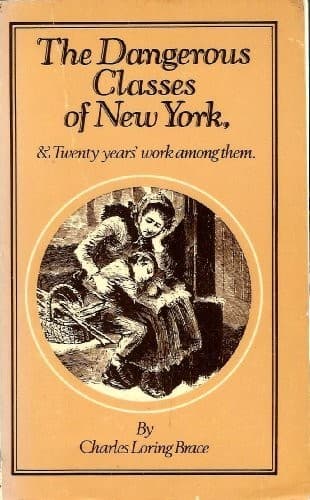
The Dangerous Classes of New York, and Twenty Years' Work Among ThemBrace, Charles Loring
History
The Dangerous Classes of New York, and Twenty Years' Work Among Them
Brace, Charles Loring
Child welfare -- New York (State) -- New York; New York (N.Y.) -- Social conditions; Poor -- New York (State) -- New York
By and by, one organization falls behind in its charity labors, and now,
in place of waiting to carefully assist the poor, it tempts the poor to
come to it. If it be a peculiar kind of school, not much needed in the
quarter, it bribes the poor children by presents to abandon the rival
school and fill its own seats; if an Asylum, it seeks far and near for
those even not legitimately its subjects. There arises a sort of
competition of charity. This kind of rivalry is exceedingly bad both for
the poor and the public. There are evils enough in the community which
all our machinery and wealth cannot cure, and thus to increase or
stimulate misfortunes in order to relieve, is the height of absurdity.
One effect often is, that the public become disgusted with all organized
charity, and at last fancy that societies of benefaction do as much evil
as good.
This city is full of multiplied charities, which are constantly
encroaching on each other's field; and yet there are masses of evil and
calamity here which they scarcely touch. The number of poor people who
enjoy a comfortable living, derived from a long study and experience of
these various agencies of benevolence, would be incredible to any one
not familiar with the facts. They pass from one to the other; knowing
exactly their conditions of assistance and meeting their requirements,
and live thus by a sort of science of alms. The industry and ingenuity
they employ in this pauper trade are truly remarkable. Probably not one
citizen in a thousand could so well recite the long list of charitable
societies and agencies in New York, as one of these busy dependents on
charity. Nor do these industrious paupers confine themselves to secular
and general societies. They have their churches and missions, on whose
skirts they hang; and beyond them a large and influential circle of lady
patronesses who support and protect them. We venture to say there are
very few ladies of position in New York who do not have a numerous
_clientele_ of needy women or unfortunate men that depend on them year
after year, and always follow them up and discover their residence,
however much they may change it. These people have almost lost their
energy of character, and all power of industry (except in pursuing the
different charities and patronesses), through this long and
indiscriminate assistance. They are paupers, not in Poor-houses, and
dependents on alms, living at home. They are often worse off than if
they had never been helped.
This trade of alms and dependence on charities ought to be checked. It
demoralizes the poor, and weakens public confidence in wise and good
charities. It tends to keep the rich from all benefactions, and makes
many doubt whether charity ever really benefits.
Public-domain text, read in full here on John Shaqi.
Reviews
Reviews
No reviews yet
Be the first to share your thoughts on this work.
Elsewhere in the archive
Join the Discussion
Join the discussion
Sign in to leave a comment or review.
Sign InorCreate an account