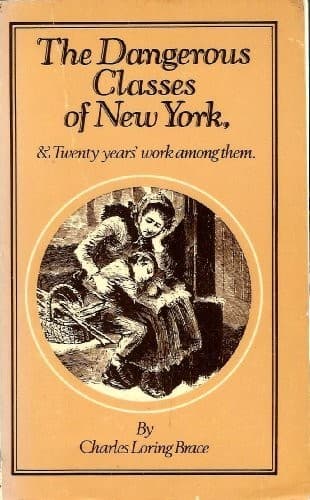
The Dangerous Classes of New York, and Twenty Years' Work Among ThemBrace, Charles Loring
History
The Dangerous Classes of New York, and Twenty Years' Work Among Them
Brace, Charles Loring
Child welfare -- New York (State) -- New York; New York (N.Y.) -- Social conditions; Poor -- New York (State) -- New York
There are various modes in which this evil might be remedied. In the
first place, no individual should subscribe to a new charity until he
has satisfied his mind in some way that it is needed, and that he is not
helping to do twice the same good thing.
There ought to be also in such a city as ours a sort of "Board" or
"Bureau of Charities," where a person could get information about all
now existing, whether Catholic, Protestant, Jewish, or secular, and
where the agents of these could ascertain if they were helping the same
objects twice.
Lists of names and addresses of those assisted could be kept here for
examination, and frequent comparisons could be made by the agents of
these societies or by individuals interested. One society, formed for a
distinct object, and finding a case needing quite a distinct mode of
relief or assistance, could here at once ascertain where to transfer the
case, or what the conditions of help were in another association. Here,
individuals having difficult, perplexing, or doubtful cases of charity
on hand would ascertain what they should do with them, and whether they
were merely supporting a person now dependent on an association from
such an office. Cases of poverty and misfortune might be visited and
examined by experts, in charity, and the truth ascertained, where
ordinary individuals, inquiring, would be certain to be deceived. Here,
too, the honest and deserving poor could learn where they should apply
for relief.
Such a "Bureau" would be of immense benefit to the city. It would aid in
keeping the poor from pauperism; it would put honest poverty in the way
of proper assistance; simplify and direct charities, and enable the
"charity fund" of the city to be used directly for the evils needing
treatment.
Both the public and benevolent associations would be benefited by it,
and much useless expenditure and labor saved. Under it, each charitable
association could labor in its own field, and encroach on no other, and
the public confidence in the wise use of charity funds be strengthened.
In such a city as ours it would probably be hardly possible to follow
the Boston plan, and put all the offices of the great charities in one
building, yet there could easily be one office of information, or a
"Bureau of Charities," which might be sustained by general
contributions. Perhaps the State "Board of Charities" would father and
direct it, if private means supported it.
In one respect, it would be of immense advantage to have this task
undertaken by the State Board, as they have the right to inspect
charitable institutions, and their duty is to expose "bogus charities."
Of the latter there are only too many in this city. Numerous lazy
individuals make lucrative livelihoods by gathering funds for charities
which only exist on paper. These swindlers could be best exposed and
prosecuted by a "State Board."
CHAPTER XXXII.
HOW BEST TO GIVE ALMS?
Public-domain text, read in full here on John Shaqi.
Reviews
Reviews
No reviews yet
Be the first to share your thoughts on this work.
Elsewhere in the archive
Join the Discussion
Join the discussion
Sign in to leave a comment or review.
Sign InorCreate an account