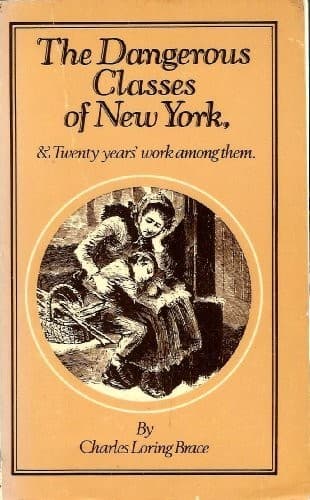
The Dangerous Classes of New York, and Twenty Years' Work Among ThemBrace, Charles Loring
History
The Dangerous Classes of New York, and Twenty Years' Work Among Them
Brace, Charles Loring
Child welfare -- New York (State) -- New York; New York (N.Y.) -- Social conditions; Poor -- New York (State) -- New York
We are convinced that it ought to be, if not abandoned, at least much
circumscribed by our own Commissioners of Charities.
Still, private alms, though more indiscriminately bestowed, and often on
entirely unworthy objects, do not, in our judgment, leave the same evil
effect as public. There is less degradation with the former, and more of
human sympathy, on both sides. The influence of the giver's character
may sometimes elevate the debased nature of an unworthy dependent on
charity. The personal connection of a poor creature and a fine lady, is
not so bad as that of a pauper to the State.
Still, private alms in our large cities are abused to an almost
unlimited extent. Persons who have but little that they can afford to
give, discover, after long experience, that the majority of their
benefactions have been indiscreetly bestowed.
When one thinks of the thousands of cases in a city like New York, of
unmitigated misfortune; of widows with large families, suddenly left
sick and helpless on the world; of lonely and despairing women
struggling against a sea of evils; of strong men disabled by accident or
sickness; of young children abandoned or drifting uncared-for on the
streets, and how many of these are never wisely assisted, it seems a
real calamity that any person should bestow charity carelessly or on
unworthy objects.
The individual himself ought to seek out the subjects whom he desires to
relieve, and ascertain their character and habits, and help in such a
way as not to impair their self-respect or weaken their independence.
The managers of the Charity I have been describing have especially
sought to avoid the evils of alms-giving. While many thousands of
dollars' worth is given each year in various forms of benefaction, not a
penny is bestowed which does not bear in its influence on character. We
do not desire so much to give alms as to prevent the demand for alms. In
every branch of our work we seek to destroy the growth of pauperism.
Nothing in appearance is so touching to the feelings of the humane as a
ragged and homeless boy. The first impulse is to clothe and shelter him
free of cost. But experience soon shows that if you put a comfortable
coat on the first idle and ragged lad who applies, you will have fifty
half-clad lads, many of whom possess hidden away a comfortable outfit,
leaving their business next day, "to get jackets for nothing."
You soon discover, too, that the houseless boy is not so utterly
helpless as he looks. He has a thousand means of supporting himself
honestly in the streets, if he will. Perhaps all that he needs is a
small loan to start his street-trade with, or a shelter for a few
nights, for which he can give his "promise to pay," or some counsel and
instruction, or a few weeks' schooling.
Public-domain text, read in full here on John Shaqi.
Reviews
Reviews
No reviews yet
Be the first to share your thoughts on this work.
Elsewhere in the archive
Join the Discussion
Join the discussion
Sign in to leave a comment or review.
Sign InorCreate an account