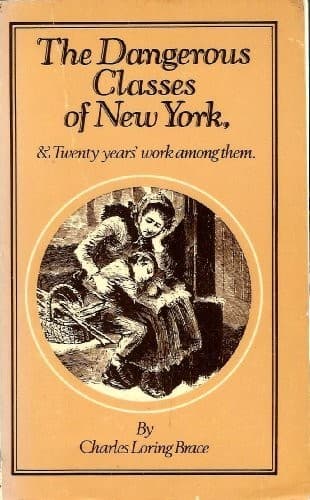
The Dangerous Classes of New York, and Twenty Years' Work Among ThemBrace, Charles Loring
History
The Dangerous Classes of New York, and Twenty Years' Work Among Them
Brace, Charles Loring
Child welfare -- New York (State) -- New York; New York (N.Y.) -- Social conditions; Poor -- New York (State) -- New York
Our Lodging-house-keepers soon learn that the best humanity towards the
boys is "to take, not give." Each lad pays for his lodging, and then
feels independent; if he is too poor to do this, he is taken in "on
trust," and pays his bill when business is successful. He is not clothed
at once, unless under some peculiar and unfortunate circumstances, but
is induced to save some pennies every day until he have enough to buy
his own clothing. If he has not enough to start a street-trade with, the
superintendent loans him a small sum to begin business.
The following is the experience in this matter of Mr. O'Connor, the
superintendent of the Newsboys' Lodging-house:--
"The Howland Fund, noticed in previous reports as having been
established by B. J. Howland, Esq., one of our Trustees, continues to be
the means of doing good. We have loaned from it during the nine months
one hundred and twenty-three dollars and sixty cents, on which the
borrowers have realized three hundred and seven dollars and thirty-nine
cents. They have thus made the handsome profit of two hundred and fifty
per cent. on the amount borrowed. It has in many cases been returned in
a few hours. We have loaned it in sums of five cents and upward; we have
had but few defaulters. Of the seventeen dollars and fifty-five cents
due last year, six dollars and fifty cents has been returned, leaving at
this time standing out eleven dollars and five cents."
When large supplies of shoes and clothing are given, it is usually at
Christmas, as an expression of the good-will of the season, or from some
particular friend of the boys as an indication of his regard, and thus
carries less of the ill effects of alms with the gift.
The very air of these Lodging-houses is that of independence, and no
paupers ever graduate from them. We even discourage the street-trades as
a permanent business, and have, therefore, never formed a "Boot-black
Brigade," as has been done in London, on the ground that such
occupations are uncertain and vagrant in habit, and lead to no settled
business.
Our end and aim with every street-rover, is to get him to a farm, and
put him on the land. For this reason we lavish our gifts on the lads who
choose the country for their work. We feed and shelter them
gratuitously, if necessary. We clothe them from top to toe; and the
gifts bring no harm with them. These poor lads have sometimes repaid
these gifts tenfold in later life, in money to the Society. And the
community have been repaid a hundredfold, by the change of a city
vagabond to an honest and industrious farmer.
Our Industrial Schools might almost be called "Reformatories of
Pauperism." Nine-tenths of the children are beggars when they enter, but
they go forth self-respecting and self-supporting young girls.
Public-domain text, read in full here on John Shaqi.
Reviews
Reviews
No reviews yet
Be the first to share your thoughts on this work.
Elsewhere in the archive
Join the Discussion
Join the discussion
Sign in to leave a comment or review.
Sign InorCreate an account