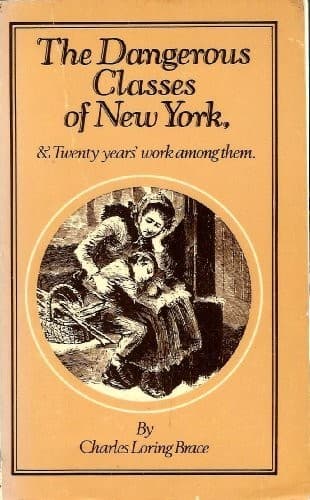
The Dangerous Classes of New York, and Twenty Years' Work Among ThemBrace, Charles Loring
History
The Dangerous Classes of New York, and Twenty Years' Work Among Them
Brace, Charles Loring
Child welfare -- New York (State) -- New York; New York (N.Y.) -- Social conditions; Poor -- New York (State) -- New York
The whole matter is thoroughly organized; there are agents to forward
the nurses and children, inspectors to select nurses and look after the
infants and take charge of the disbursements, and medical officers to
investigate the condition of both children and nurses, and to visit them
monthly, and give medical attendance. The nurse is obliged to bring a
certificate of good character from the Commune, and of her being in
proper condition to take care of a foster-child. She is not permitted to
take charge of an infant unless her own is nine months old, and has been
weaned. The nurse is bound to send her foster-child, as she grows up, to
school, and to some place of religious instruction. The bureau has thus
relieved a great number of children during ten years, from 1855 to 1864,
the total number amounting to 21,944.
That it has been wonderfully successful is shown by the mortality, which
is now only about thirty per cent., or nearly the same with the general
death-rate among young children in New York. Under this new poor-law
administration for destitute and abandoned children, the famous Hospital
for Foundlings has been changed into a mere depot for children sent to
places and nurses in the country, with the most happy results in point
of mortality. Thus, in 1838, the hospital admitted 5,322 children, and
lost 1,211; in 1868, of 5,603 admitted, only 442 died, or about eight
per cent. Of 21,147 sent to the country, the deaths were only 1,783, or
less than ten per cent Of 6,009 admitted in 1869, 4,260 were abandoned
children, and the deaths from the above number were 495.
The French administration does not cease with paying the board of these
foundlings in their country homes; it looks carefully after their
clothing, their education, their religious instruction, and even their
habits of economy. The outlay by the Government for these various
objects is considerable. In 1869, the traveling expenses of these little
waifs reached the sum of 170,107 francs. The payments to the peasants to
induce them to educate the foundlings amounted to 85,458 francs for the
same year; the savings of the children, put in official savings-boxes,
amounted to 394,076 francs, while 15,936 francs were given out as
prizes.
The moral effects have been encouraging. In 1869, out of the 9,000
_eleves_ from thirteen to twenty-eight years, only thirty-two had
appeared before Courts of Justice for trifling offenses; thirty-two had
shown symptoms of insubordination, and nearly the same number had been
imprisoned.
Public-domain text, read in full here on John Shaqi.
Reviews
Reviews
No reviews yet
Be the first to share your thoughts on this work.
Elsewhere in the archive
Join the Discussion
Join the discussion
Sign in to leave a comment or review.
Sign InorCreate an account