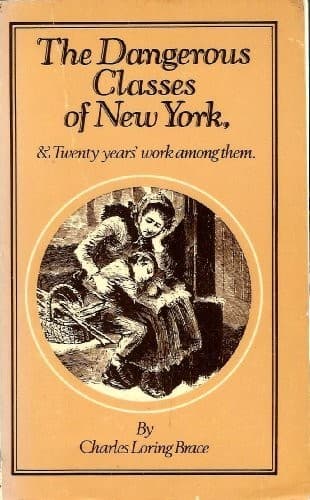
The Dangerous Classes of New York, and Twenty Years' Work Among ThemBrace, Charles Loring
History
The Dangerous Classes of New York, and Twenty Years' Work Among Them
Brace, Charles Loring
Child welfare -- New York (State) -- New York; New York (N.Y.) -- Social conditions; Poor -- New York (State) -- New York
It should be remembered that this bureau has charge of the whole class
of juvenile paupers, or Almshouse children, in Paris, as well as
foundlings, whom it treats by placing out in country homes. In 1869, it
thus provided for and protected 25,486 children, of whom 16,845 were
from one day to twelve years, and 9,001 from twelve to twenty-one years.
For this purpose, it employed two principal inspectors, twenty-five
sub-inspectors, and two hundred and seventy-eight physicians.
The expense of this bureau has been wonderfully slight, only averaging
two dollars and sixty cents per annum for each child. In an Asylum the
average annual expenditure for each child could not have been less than
one hundred and fifty dollars. This Bureau Ste. Apolline must be
carefully distinguished from the private bureaus in Paris for assisting
foundlings, under which the most shocking abuses have occurred, the
death-rate reaching among their subjects 70.87, and even ninety per
cent.
The "boarding-out" system has been a part of the Alms-house system of
Hamburg for years, and has proved eminently successful and economical.
In Berlin, more than half the pauper children, and all the foundlings,
are thus dealt with. In Dublin, both Protestant and Catholic
associations have pursued this plan with destitute orphans and
foundlings, with marked success. The Protestant Society had, in 1866,
453 orphans under its charge, and had placed out, or returned to
friends, 1,256; its provincial branches had 2,208 under their care, and
had placed out 5,374. All the orphans placed out by the Society are
apprenticed. Great care is used in inspecting the homes in which
children are put, and in selecting employers. The whole Association is
well organized. The annual cost of the children, dividing the whole
expense by the number of children placed and cared for, is only from
fifty dollars to fifty-five dollars per head. The Roman Catholic
Association, St. Brigid's, is even more economical in its work, as the
labor is mainly performed by the members of the sisterhoods. Within
seven years five hundred children were taken in charge, of whom two
hundred had been adopted or placed out. The children thus provided for
in country families are constantly visited by the conductors of the
orphanage and by the parish priest. The expense of the whole enterprise
is very slight.
Similar experiments are being made in England with pauper children, and,
despite Prof. Fawcett's somewhat impractical objections, they have been
found to be successful and far more economical than the old system.
THE FAMILY PLAN.
Public-domain text, read in full here on John Shaqi.
Reviews
Reviews
No reviews yet
Be the first to share your thoughts on this work.
Elsewhere in the archive
Join the Discussion
Join the discussion
Sign in to leave a comment or review.
Sign InorCreate an account