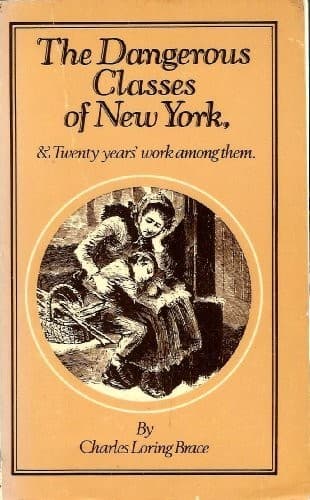
The Dangerous Classes of New York, and Twenty Years' Work Among ThemBrace, Charles Loring
History
The Dangerous Classes of New York, and Twenty Years' Work Among Them
Brace, Charles Loring
Child welfare -- New York (State) -- New York; New York (N.Y.) -- Social conditions; Poor -- New York (State) -- New York
The problem is to guard such a human being, so exposed, against powerful
temptations; to raise him above them; to melt his bad habits and
inherited faults in some new and grand emotion; to create within him a
force which is stronger than, and utterly opposed to, the selfish greed
for money, or the attractions of criminal indulgence, or the rush of
passion, or the fire of anger. The object is to implant in his breast
such a power as Plato dreamed of--the Love of some perfect Friend, whose
character by sympathy shall purify his, whose feeling is believed to go
with the fortunes of the one forgotten by all others, and who has the
power of cleansing from wrong and saving from sin.
The experience of twenty years' labor shows us that what are called
"moral influences" are not sufficient to solve this problem, or meet
this want among the children of the street. It is, of course, well at
times to present the beauty of virtue and the ugliness of vice; to show
that honesty brings rewards, and falsehood pains, and to sketch the
course of the moral poor whom fortune has rewarded. But these
considerations are not sufficiently strong to hold back the most
pressing temptations. Moreover, we have often had grave doubts whether
"the bread-and-butter piety" was not too much recommended in all
religious meetings to children. The child is too continually reminded
that righteousness brings reward in this world, though the Master calls
us to "take a yoke," and "bear a cross." The essence of the religious
impulse is that it is unselfish, an inspiration from above, not below, a
quickening of the nobler emotions and higher aspirations. Wherever gain
or worldly motive comes in, there spirituality flees away. We have,
accordingly, always opposed, in our religious meetings, the employment
of prizes or rewards, as is so common in Sunday Schools, to strengthen
the religious influence. Experience, as well as reason, has shown us
that all such motives mingled with religion simply weaken its power.
Public-domain text, read in full here on John Shaqi.
Reviews
Reviews
No reviews yet
Be the first to share your thoughts on this work.
Elsewhere in the archive
Join the Discussion
Join the discussion
Sign in to leave a comment or review.
Sign InorCreate an account