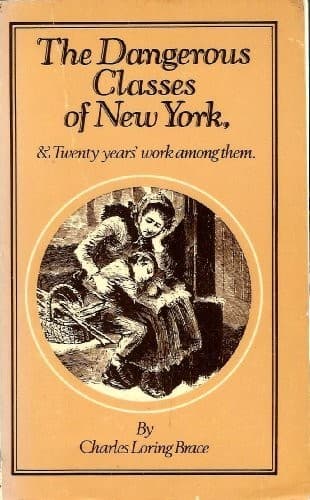
The Dangerous Classes of New York, and Twenty Years' Work Among ThemBrace, Charles Loring
History
The Dangerous Classes of New York, and Twenty Years' Work Among Them
Brace, Charles Loring
Child welfare -- New York (State) -- New York; New York (N.Y.) -- Social conditions; Poor -- New York (State) -- New York
The children themselves are in a peculiar position. They have many of
the traits of children, and yet are struggling in an independent and
hard life, like men. They are not to be influenced as a Sunday-school
audience would be, nor as an audience of adults. Their minds are acute,
sharp, and practical; mere sentiment and the amiable platitudes of
Sunday-school oratory are not for them. Rhetoric sets them asleep.
Bombast goes by the name of "gas" among them. Sentimental and
affectionate appeals only excite their contempt. The "hard fact" pleases
them. They know when the speaker stands on good bottom. If he has
reached "hard pan," his audience is always with him.
No audience is so quick to respond to a sudden turn or a joke. Their
faculties are far more awake than those of a company of children of the
fortunate classes. And yet they are like children in many respects.
Nothing interests them so much as the dramatic: the truth given by
parable and illustration. Their education in the low theatres has
probably cultivated this taste. The genuine and strong feeling of the
heart always touches them. I have seen the quick tears drop over the
dirty cheeks at the simple tone only of some warm-hearted man who had
addressed them with a deep feeling of their loneliness and desolation.
And yet they would have "chaffed" him in five minutes after, if they had
had the opportunity. They seem to have children's receptivity; they are
not by nature skeptical. They unconsciously believe in supernatural
powers, or in one eternal Power. Their conscience can be reached; the
imagination is, to a certain degree, lively; they are peculiarly open to
Religion. And yet their "moral" position is a most perplexing one. The
speaker in one of our Boys' Lodging-houses, who addresses them, knows
that this may be the last and only time, for years, that many of the
wild audience will listen to religious truth. To-morrow a considerable
portion will be scattered, no one knows where. To-morrow, perhaps
to-night, temptation will come in like a flood. In a few hours, it may
be, the street-boy will stand where he must decide whether he will be a
thief or an honest lad; a rogue or an industrious worker; the companion
of burglars and murderers, or the friend of the virtuous. Temptations to
lying, to deceit, to theft, robbery, lust, and murder will soon hunt him
like a pack of wolves. His child's nature is each day under the strain
of a man's temptations. Poverty, hunger, and friendlessness add to his
exposed condition, while, in all probability, he inherits a tendency to
indulgence or crime.
Public-domain text, read in full here on John Shaqi.
Reviews
Reviews
No reviews yet
Be the first to share your thoughts on this work.
Elsewhere in the archive
Join the Discussion
Join the discussion
Sign in to leave a comment or review.
Sign InorCreate an account