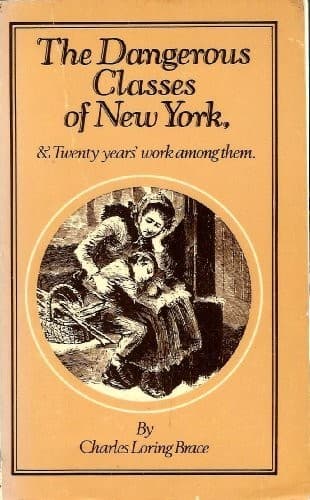
The Dangerous Classes of New York, and Twenty Years' Work Among ThemBrace, Charles Loring
History
The Dangerous Classes of New York, and Twenty Years' Work Among Them
Brace, Charles Loring
Child welfare -- New York (State) -- New York; New York (N.Y.) -- Social conditions; Poor -- New York (State) -- New York
Still, were the indulgences of the two sexes of a similar character--as
in savage races--were they both following passion alone, the moral
effect would not perhaps be so different in the two cases. But the sin
of the girl soon becomes what the Bible calls "a sin against one's own
body," the most debasing of all sins. She soon learns to offer for sale
that which is in its nature beyond all price, and to feign the most
sacred affections, and barter with the most delicate instincts. She no
longer merely follows blindly and excessively an instinct; she perverts
a passion and sells herself. The only parallel case with the male sex
would be that in some Eastern communities which are rotting and falling
to pieces from their debasing and unnatural crimes. When we hear of such
disgusting offenses under any form of civilization, whether it be under
the Rome of the Empire, or the Turkey of to-day, we know that disaster,
ruin, and death, are near the State and the people.
This crime, with the girl, seems to sap and rot the whole nature. She
loses self-respect, without which every human being soon sinks to the
lowest depths; she loses the habit of industry, and cannot be taught to
work. Having won her food at the table of Nature by unnatural means,
Nature seems to cast her out, and henceforth she cannot labor. Living in
a state of unnatural excitement, often worked up to a high pitch of
nervous tension by stimulants, becoming weak in body and mind, her
character loses fixedness of purpose and tenacity and true energy. The
diabolical women who support and plunder her, the vile society she
keeps, the literature she reads, the business she has chosen or fallen
into, serve continually more and more to degrade and defile her. If, in
a moment of remorse, she flee away and take honest work, her weakness
and bad habits follow her; she is inefficient, careless, unsteady, and
lazy; she craves the stimulus and hollow gayety of the wild life she has
led; her ill name dogs her; all the wicked have an instinct of her
former evil courses; the world and herself are against reform, and,
unless she chance to have a higher moral nature or stronger will than
most of her class, or unless Religion should touch even her polluted
soul, she soon falls back, and gives one more sad illustration of the
immense difficulty of a fallen woman rising again.
Public-domain text, read in full here on John Shaqi.
Reviews
Reviews
No reviews yet
Be the first to share your thoughts on this work.
Elsewhere in the archive
Join the Discussion
Join the discussion
Sign in to leave a comment or review.
Sign InorCreate an account