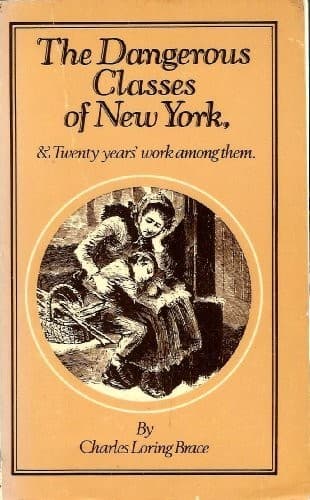
The Dangerous Classes of New York, and Twenty Years' Work Among ThemBrace, Charles Loring
History
The Dangerous Classes of New York, and Twenty Years' Work Among Them
Brace, Charles Loring
Child welfare -- New York (State) -- New York; New York (N.Y.) -- Social conditions; Poor -- New York (State) -- New York
The great majority of prostitutes, it must be remembered, have had no
romantic or sensational history, though they always affect this. They
usually relate, and perhaps even imagine, that they have been seduced
from the paths of virtue suddenly and by the wiles of some heartless
seducer. Often they describe themselves as belonging to some virtuous,
respectable, and even wealthy family. Their real history, however, is
much more commonplace and matter-of-fact. They have been poor women's
daughters, and did not want to work as their mothers did; or they have
grown up in a tenement-room, crowded with boys and men, and lost purity
before they knew what it was; or they have liked gay company, and have
had no good influences around them, and sought pleasure in criminal
indulgences; or they have been street-children, poor, neglected, and
ignorant, and thus naturally and inevitably have become depraved women.
Their sad life and debased character are the natural outgrowth of
poverty, ignorance, and laziness. The number among them who have "seen
better days," or have fallen from heights of virtue, is incredibly
small. They show what fruits neglect in childhood, and want of education
and of the habit of labor, and the absence of pure examples, will
inevitably bear. Yet in their low estate they always show some of the
divine qualities of their sex. The physicians in the Blackwell's Island
Hospital say that there are no nurses so tender and devoted to the sick
and dying as these girls. And the honesty of their dealings with the
washerwomen and shopkeepers, who trust them while in their vile houses,
has often been noted.
The words of sympathy and religion always touch their hearts, though the
effect passes like the April cloud. On a broad scale, probably no remedy
that man could apply would ever cure this fatal disease of society. It
may, however, be diminished in its ravages, and prevented in a large
measure. The check to its devastations in a laboring or poor class will
be the facility of marriage, the opening of new channels of female work,
but, above all, the influences of education and Religion.
An incident occurred daring our early labors, which is worth
preserving:
EXTRACTS FROM JOURNAL DURING 1854.
THE TOMBS.
"Mrs. Forster, the excellent Matron of the Female Department of the
prison, had told us of an interesting young German girl, committed for
vagrancy, who might just at this crisis be rescued. I entered these
soiled and gloomy Egyptian archways, so appropriate and so depressing,
that the sight of the low columns and lotus capitals is to me now
inevitably associated with the somber and miserable histories of the
place.
Public-domain text, read in full here on John Shaqi.
Reviews
Reviews
No reviews yet
Be the first to share your thoughts on this work.
Elsewhere in the archive
Join the Discussion
Join the discussion
Sign in to leave a comment or review.
Sign InorCreate an account