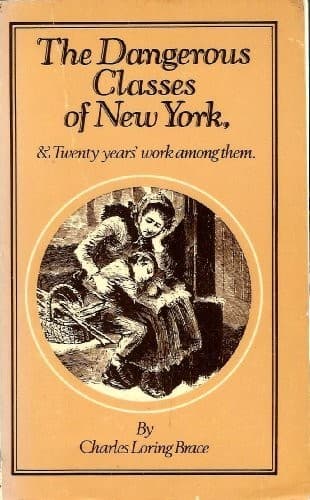
The Dangerous Classes of New York, and Twenty Years' Work Among ThemBrace, Charles Loring
History
The Dangerous Classes of New York, and Twenty Years' Work Among Them
Brace, Charles Loring
Child welfare -- New York (State) -- New York; New York (N.Y.) -- Social conditions; Poor -- New York (State) -- New York
A most gifted intellectual family, the S----s, supplied some of our most
devoted workers; the wife, since deceased, of one of our leading
merchants and public men, himself a man much loved for his generosity,
occupied the place of one of the Directresses; the wife of a prominent
physician was our Treasurer. A young lady of fortune, since dead, Miss
G., took the hardest labors upon herself. The wife of a gentleman since
Governor and United States Senator, was in especial charge of the house,
and dreaded no labor of humanity, however disagreeable. Two others,
sisters, who represented one of our most honored historical families,
but whose characters needed no help of genealogy to make them esteemed
by all, threw themselves into the work with characteristic earnestness.
Another of that family, which has furnished the pioneer of all
reform-work among the youthful criminals, and in criminal law, and which
in the early days of our history so often led public affairs, visited
from house to house among the miserable poor of the ward, and twice
found herself face to face with small-pox in its most virulent form.
The effects of this particular School upon the morals of the juvenile
population of the Fourth Ward were precisely what they have always been
in similar schools. These little girls, who might be said to be almost
the inmates of the brothels, and who grew up in an atmosphere of crime
and degradation, scarcely ever, when mature, joined the ranks of their
sisters and neighbors. Though living in the same houses with the gay
dance-saloons, they avoided them as they would pestilential places.
Trained to industry and familiar with the modest and refined appearance
of pure women in the schools, they had no desire for the society of
these bold girls, or to earn their living in this idle and shameful
manner. They felt the disgrace of the abandoned life around them, and
were soon above it. Though almost invariably the children of drunkards,
they did not inherit the appetites of their mothers, or if they did,
their new training substituted higher and stronger desires. They were
seldom known to have the habit of drinking as they grew up. Situations
were continually found for them in the country, or they secured places
for themselves as servants in respectable families; and, becoming each
day more used to better circumstances and more neatly dressed, they had
little desire to visit their own wretched homes and remain in their
families. Now and then there would be a fall from virtue among them, but
the cases were very few indeed. As they grew up they married young
mechanics or farmers, and were soon far above the class from which they
sprang. Such were the fruits in general of the patient, self-denying
labors of these ladies in the Fourth Ward School.
Public-domain text, read in full here on John Shaqi.
Reviews
Reviews
No reviews yet
Be the first to share your thoughts on this work.
Elsewhere in the archive
Join the Discussion
Join the discussion
Sign in to leave a comment or review.
Sign InorCreate an account