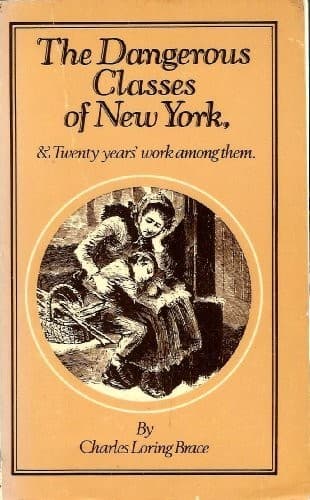
The Dangerous Classes of New York, and Twenty Years' Work Among ThemBrace, Charles Loring
History
The Dangerous Classes of New York, and Twenty Years' Work Among Them
Brace, Charles Loring
Child welfare -- New York (State) -- New York; New York (N.Y.) -- Social conditions; Poor -- New York (State) -- New York
Into this community of poor, ignorant, and drunken people I threw
myself, and resolved, with God's aid, to try to do something for them.
Here for years I visited from cabin to cabin, or hunted out every cellar
and attic of the neighboring tenement-houses; standing at death-beds and
sick-beds, seeking to administer consolation and advice, and, aided by
others, to render every species of assistance.
In returning home from these rounds, amidst filth and poverty, I
remember that I was frequently so depressed and exhausted as to throw
myself flat upon the rug in front of the fire, scarcely able to move.
The discouraging feature in such visits as I was making, and which must
always exist in similar efforts, is that one has no point of religious
contact with these people.
Among all the hundreds of families I knew and visited I never met but
two that were Protestants. To all words of spiritual warning or help
there came the chilling formalism of the ignorant Roman Catholic in
reply, implying that certain outward acts made the soul right with its
Creator. The very inner ideas of our spiritual life of free love towards
God, true repentance and trust in a Divine Redeemer, seemed wanting in
their minds. I never had the least ambition to be a proselytizer, and
never tried to convert them, and I certainly had no prejudice against
the Romanists; on the contrary, it has been my fortune in Europe to
enjoy the intercourse of some most spiritual-minded Catholics. But these
poor people seemed stamped with the spiritual lifelessness of Romanism.
At how many a lonely death-bed or sick-bed, where even the priest had
forgotten to come, have I longed and tried to say some comforting word
of religion to the dull ear, closing to all earthly sounds; but even if
heard and the sympathy gratefully felt, it made scarcely more religious
impression than would the chants of the Buddhists have done. One
sprinkle of holy water were worth a volume of such words.
A Protestant has great difficulty in coming into connection with the
Romanist poor. I was often curious to know the exact influence of the
priests over these people. The lowest poor in New York are not, I think,
much cared for by the Romanist priesthood. One reason, without doubt, is
that their attention has thus far been mainly (and wisely) directed to
building handsome churches, and that they have not means to do much for
these persons. Another and more powerful reason is, probably, that the
old "enthusiasm of humanity" which animated a Guy, a Vincent de Paul, or
Xavier, has died out among them.
I have known, however; individual cases in our city, where a priest has
exercised a marked influence in keeping his charge from intoxication.
There were also occasionally, in this very region, something like
"Revivals of Religion" among the people, stimulated by the priests, in
which many young girls joined religious societies, and did lead, to my
knowledge, for a time more pure and devout lives.
Public-domain text, read in full here on John Shaqi.
Reviews
Reviews
No reviews yet
Be the first to share your thoughts on this work.
Elsewhere in the archive
Join the Discussion
Join the discussion
Sign in to leave a comment or review.
Sign InorCreate an account