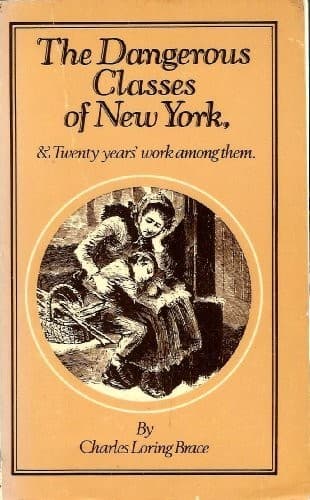
The Dangerous Classes of New York, and Twenty Years' Work Among ThemBrace, Charles Loring
History
The Dangerous Classes of New York, and Twenty Years' Work Among Them
Brace, Charles Loring
Child welfare -- New York (State) -- New York; New York (N.Y.) -- Social conditions; Poor -- New York (State) -- New York
When one thinks what a noble-minded and humane Priest might accomplish
among the lowest classes of New York, how many vices he could check, and
what virtues he might cherish, and what public blessings on the whole
community he might confer, by elevating this degraded population; and
then as one looks at the moral condition of the Roman Catholic poor, one
can only sigh, that that once powerful body has lost so much of the
inspiration of Christ which once filled it.
The plan which I laid out in working in this quarter was in harmony with
all our previous efforts; it was especially to influence and improve the
children.
It so happened that near "Dutch Hill" was another hill covered with
handsome houses and inhabited by wealthy people, "Murray Hill." The
ladies in this prosperous quarter were visited, and finally assembled in
a public meeting; and, with the same preliminaries as in the other
Schools, we at length organized in 1854.
THE EAST RIVER INDUSTRIAL SCHOOL.
Early in the history of this School, we secured the services of a lady,
Miss Spratt, now Mrs. Hurley, who has been ever since the main-stay of
that most useful charity.
For seventeen years this woman of refinement and education has spent her
days in this School of poor children, and her hours of leisure in those
wretched shanties--an angel of mercy and sympathy to every unfortunate
family for miles around. Whatever woman falls into misfortune, loses
husband or child, is driven from home by poverty, or forced from work by
depression of business, or meets with troubles of mind or body, at once
comes to her for sympathy and relief. She has become so used to scenes
of misery, that to her, she says, "the house of mourning" is more
natural than "the house of feasting."
The present writer, for his own part, confesses that he could not
possibly have borne the harrowing and disagreeable scenes with which he
has been so long familiar, without making a strict rule never to think
or speak of the poor when he was away from his work, and immediately
absorbing himself in some entirely different subject. The spring of the
mind would have been broken.
But Mrs. Hurley lived in and for the poor; her only relaxation was
hearing Mr. Beecher on Sunday; and yet, when she occasionally visited us
in the country, she devoured books--her great favorite being a
translation I had of Plato.
The children, of course, became passionately attached to this missionary
of charity. During her labors, she was married to a physician, Dr.
Hurley, who subsequently was killed in the army during the War of the
Rebellion. While she was temporarily absent, and a strange teacher
employed, six of the wildest girls were expelled, so unmanageable were
they. When she came back, they returned and welcomed her eagerly,
behaving perfectly well; and it was discovered that so attached were
they to her, they had each carried fragments of her dress as mementos in
their bosom!
Public-domain text, read in full here on John Shaqi.
Reviews
Reviews
No reviews yet
Be the first to share your thoughts on this work.
Elsewhere in the archive
Join the Discussion
Join the discussion
Sign in to leave a comment or review.
Sign InorCreate an account