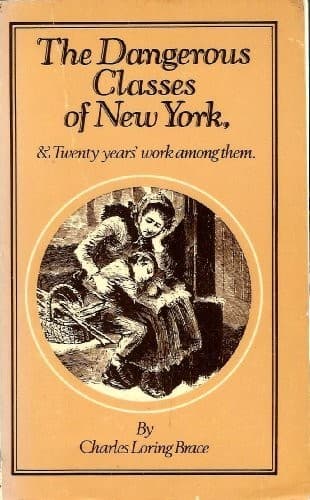
The Dangerous Classes of New York, and Twenty Years' Work Among ThemBrace, Charles Loring
History
The Dangerous Classes of New York, and Twenty Years' Work Among Them
Brace, Charles Loring
Child welfare -- New York (State) -- New York; New York (N.Y.) -- Social conditions; Poor -- New York (State) -- New York
"In East Thirty-fourth Street, in a tenement-house, a poor sewing-woman
has lived for the last two years. She had formerly been in very good
circumstances, and her husband, a respectable mechanic, earned a support
for her and her children, until at length he fell into intemperate
drinking. With the appetite for liquor on him, everything that he made
was spent, and he himself was gradually becoming worse and worse. The
poor wife was forced to the hardest work to keep her children and
herself alive. Last winter, in a moment of desperation, the husband put
his name down for a three-years' whaling voyage, and was taken off to
sea, leaving the woman with an old father and three children to care
for. Many a night, the old man says, has the poor creature walked up
from the lower part of the city (some three or four miles) with four
dozen shirts on her back, through snow and wet, and then, without fire
or food, in her wet clothes, has worked till the dawn of day for the
poor little ones dependent on her. He has seen _the blood_ come from her
mouth and nose after some of these efforts. Still more bitter than all
this, was the sense of desertion by her husband. But it was all in vain.
The children for whom she had slaved, and whom she loved more than her
own life, were attacked with scarlet fever, and two of them died in the
mother's arms. One only, a sweet little girl, was left. With them went
the spring of hope and courage which had sustained the hard-working
mother. Her father says she never shed a tear, but she lost heart; and,
though never doubting of the goodness of her Great Father, she had not
the spirit for the remaining work of life. Her exposures and hard labor
had brought on a cough, and finally a disease of the lungs. She was at
last unable to work, and could only lie upon her bed and depend on the
chance charities of strangers.
"The teacher of our Fortieth-street School, who, in a way unseen and
unknown to the world, is a minister of mercy and goodness to all that
quarter of the city, first discovered her, and has managed, with a
little aid here and there, to lighten her dying hours.
"I was called in the other day and held a long conversation with her.
She has no more fears or anxieties; she is not even troubled about her
little one. God will care for her. 'Once,' she said, 'I felt it so hard
to lose the children, but now I am glad they are gone! They will be much
better where they are than here. I have put everything away now,' she
added, with an expression of sublime faith and hope on a face whose worn
features the hectic flush made almost beautiful again. 'I trust all to
my Redeemer. Through him alone I hope. He will forgive me and receive
me.' She spoke of her many trials and sorrows--they were all over, and
she was glad she was soon to be at rest.
Public-domain text, read in full here on John Shaqi.
Reviews
Reviews
No reviews yet
Be the first to share your thoughts on this work.
Elsewhere in the archive
Join the Discussion
Join the discussion
Sign in to leave a comment or review.
Sign InorCreate an account