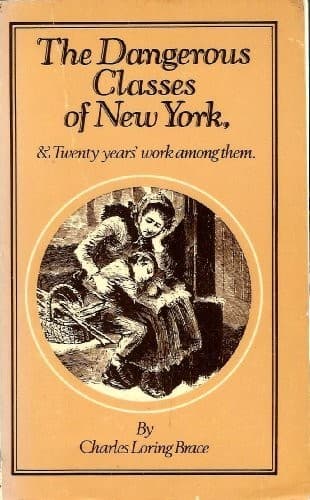
The Dangerous Classes of New York, and Twenty Years' Work Among ThemBrace, Charles Loring
History
The Dangerous Classes of New York, and Twenty Years' Work Among Them
Brace, Charles Loring
Child welfare -- New York (State) -- New York; New York (N.Y.) -- Social conditions; Poor -- New York (State) -- New York
"We asked about her food. She said she could not relish many things, and
she often thought if she could only get some of the good old plain
things she had in Ireland at her brother's farm she should feel so much
better.
"I told her we would get her some good genuine oat-meal cake from an
Irish friend. Her face lighted up at once, and she seemed cheered by the
promise.
"'Oh, sir! I have thought so much of my mother in this sickness, and
those happy, happy days. I was such a happy girl! How little she thought
I would come to this! We lived in the North, you know, and had
everything very comfortable, as all the Protestant Irish do. But it's
all gone, gone,' she said, dreamily, 'and I wouldn't have it back again,
for God is the best friend--He knows,
"'Oh, how glad I am to die!
His rod and His staff they comfort me.'
"The words were simple, but the whole was touching beyond description,
forcing tears whether one would or not.
"We were glad to find that her clergyman, the Missionary of the Calvary
Church, had administered the sacraments to her that day. May she soon be
where the sting of poverty, the rubs and blows of hard circumstances,
the loneliness of desertion, the anxiety and care, and hopelessness, and
disappointment which have followed her unhappy path, shall cease
forever, and the unfortunate one shall enter on her new and blissful
life of peace and abiding love!"
DISCOURAGEMENT.
"I was lately visiting a poor woman, who had seen better circumstances,
the wife of a worker in an iron-foundry. The room was bare but clean,
and the woman was neatly dressed, though her face looked thin and worn,
and her eyes had an unusual expression of settled, sad discouragement. A
little girl of ten or eleven sat near her tending a baby, with the same
large sad blue eyes, as if the expression of the mother had come to
receive a permanent reflection in the child's face. Her husband had been
sick for several months, which put them all behind, though now he was
getting work enough.
"'You know how it is, sir,' she said, 'with working people: if a man
falls out of work for a day, the family feels it for a week after. We
can hardly make the two ends meet when he's well, and the moment he is
sick it comes hard upon us. Many's the morning he's gone down to the
foundry without his breakfast, and I've had to send out the little Maggy
there, to the neighbors, for bits of bread, and then she's taken it down
to him.'
"'She is a beggar, then?'
"'Yes, sir, and sorrow of it. We never thought we could come to that. My
mother brought me up most dacently, and my husband, he's a very good
scholard, and could be a clark or anything, but we can't help it! We
must have bread. I would be willing to do anything, wash, scrub, or do
plain sewing; and I keep trying, but I never find anything. There seems
no help for us; and I sometimes feel clean gone and down-hearted: and
I'm troubled at other things, too."
Public-domain text, read in full here on John Shaqi.
Reviews
Reviews
No reviews yet
Be the first to share your thoughts on this work.
Elsewhere in the archive
Join the Discussion
Join the discussion
Sign in to leave a comment or review.
Sign InorCreate an account