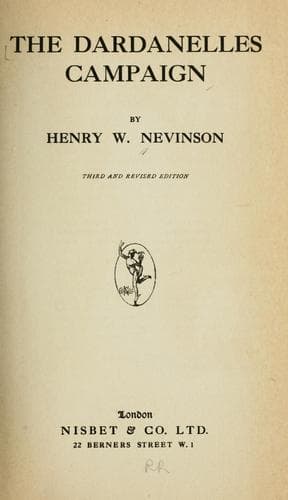
World War, 1914-1918 -- Campaigns -- Turkey -- Gallipoli Peninsula
The day was fine; the water perfectly calm; and at Imbros the 11th
Division spent the hot and sunny hours in practising disembarkation
from the unaccustomed “beetles,” or playing in naked crowds among the
shallows of Kephalos beach. The first anniversary of the war had only
just passed; most of the men had volunteered at the very beginning; the
Division had been organised for nine or ten months, and held a high
reputation in the New Army. Nevertheless, the physique and bearing were
not exceptionally fine, and, though the men displayed the cheerful and
ironic stoicism usual among English working-people, observers noticed
an absence of eager enthusiasm--of that excitement straining for
adventure which had illuminated the departure from Mudros three months
before. Hope was not so high; knowledge of the enemy’s power, or the
depressing criticism which had permeated the nation at home, increased
the common apprehensions of war; and it may be that the unconscious
paralysis of cautious and uninspiring age had crept downwards from the
higher commands, through that infection of personality which acts as by
magic for good or evil.
[Sidenote: AUGUST 6 AT HELLES]
As though perceiving this absence of devoted enthusiasm, Sir Ian
issued a characteristic Order, calculated to stir the spirits of the
troops.[150] As Commander-in-Chief, he was himself compelled to remain
at Imbros, so as to retain communication with the three principal
scenes of action, and, in case of emergency, to visit one or other
point; Suvla, the most distant, being fifty minutes, and Helles,
the nearest, only forty minutes away by torpedo-boat. So narrow is
the dividing sea that all that afternoon of August 6 the booming of
the guns, and even the incessant rattle of rifle-fire at Helles and
Anzac, could be plainly heard in the headquarters at Imbros, and by
the newcomers enjoying their last security upon the beach. For that
afternoon the two main blows designed as feints to deceive the enemy
regarding our real objective, and to hold him to his positions, were
struck, the one at Helles, the other at Anzac, as far away as was
possible from our intended advance on the left.
Public-domain text, read in full here on John Shaqi.
Reviews
Reviews
No reviews yet
Be the first to share your thoughts on this work.
Elsewhere in the archive
Join the Discussion
Join the discussion
Sign in to leave a comment or review.
Sign InorCreate an account