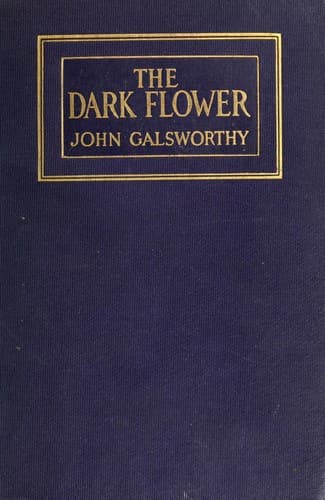
Produced by Donald Lainson; David Widger
THE DARK FLOWER
by John Galsworthy
“Take the flower from my breast, I pray thee,
Take the flower too from out my tresses;
And then go hence, for see, the night is fair,
The stars rejoice to watch thee on thy way.”
—From “The Bard of the Dimbovitza.”
CONTENTS
THE DARK FLOWER
PART I—SPRING
PART II—SUMMER
PART III—AUTUMN
THE DARK FLOWER
PART I—SPRING
I
He walked along Holywell that afternoon of early June with his short
gown drooping down his arms, and no cap on his thick dark hair. A youth
of middle height, and built as if he had come of two very different
strains, one sturdy, the other wiry and light. His face, too, was a
curious blend, for, though it was strongly formed, its expression was
rather soft and moody. His eyes—dark grey, with a good deal of light in
them, and very black lashes—had a way of looking beyond what they saw,
so that he did not seem always to be quite present; but his smile was
exceedingly swift, uncovering teeth as white as a negro's, and giving
his face a peculiar eagerness. People stared at him a little as he
passed—since in eighteen hundred and eighty he was before his time in
not wearing a cap. Women especially were interested; they perceived that
he took no notice of them, seeming rather to be looking into distance,
and making combinations in his soul.
Did he know of what he was thinking—did he ever know quite definitely
at that time of his life, when things, especially those beyond the
immediate horizon, were so curious and interesting?—the things he was
going to see and do when he had got through Oxford, where everybody
was 'awfully decent' to him and 'all right' of course, but not so very
interesting.
He was on his way to his tutor's to read an essay on Oliver Cromwell;
and under the old wall, which had once hedged in the town, he took out
of his pocket a beast. It was a small tortoise, and, with an extreme
absorption, he watched it move its little inquiring head, feeling it all
the time with his short, broad fingers, as though to discover exactly
how it was made. It was mighty hard in the back! No wonder poor old
Aeschylus felt a bit sick when it fell on his head! The ancients used
it to stand the world on—a pagoda world, perhaps, of men and beasts and
trees, like that carving on his guardian's Chinese cabinet. The Chinese
made jolly beasts and trees, as if they believed in everything having
a soul, and not only being just fit for people to eat or drive or make
houses of. If only the Art School would let him model things 'on his
own,' instead of copying and copying—it was just as if they imagined it
would be dangerous to let you think out anything for yourself!
Public-domain text, read in full here on John Shaqi.
Reviews
Reviews
No reviews yet
Be the first to share your thoughts on this work.
Join the Discussion
Join the discussion
Sign in to leave a comment or review.
Sign InorCreate an account