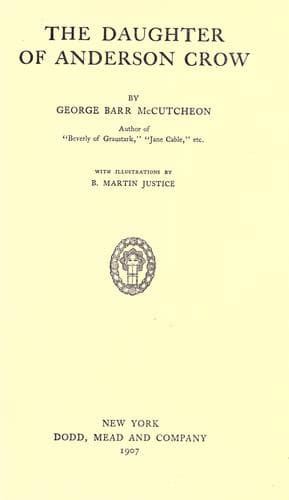
The Daughter of Anderson CrowMcCutcheon, George Barr
General
The Daughter of Anderson Crow
McCutcheon, George Barr
City and town life -- Fiction; Foundlings -- Fiction; New York (State) -- Fiction
"That's what you do, Anderson," said Mr. Lamson, as Anderson reached
over and took a handful of licorice drops from the jar on the counter.
CHAPTER IX
The Village Queen
The spring of 1903 brought Rosalie back to Tinkletown after her second
and last year with Miss Brown in New York City. The sun seemed brighter,
the birds sang more blithely, the flowers took on a new fragrance and
the village spruced up as if Sunday was the only day in the week. The
young men of the town trembled when she passed them by, and not a few of
them grew thin and haggard for want of food and sleep, having lost both
appetite and repose through a relapse in love. Her smile was the same as
of yore, her cheery greetings the same, and yet the village swains stood
in awe of this fine young aristocrat for days and days. Gradually it
dawned upon them that she was human, after all, despite her New York
training, and they slowly resumed the old-time manner of courting, which
was with the eyes exclusively.
A few of the more venturesome--but not the more ardent--asked her to go
walking, driving, or to the church "sociables," and there was a rivalry
in town which threatened to upset commerce. There was no theatre in
Tinkletown, but they delighted in her descriptions of the gorgeous
play-houses in New York. The town hall seemed smaller than ever to them.
The younger merchants and their clerks neglected business with charming
impartiality, and trade was going to "rack and ruin" until Rosalie
declined to marry George Rawlins, the minister's son. He was looked upon
as the favoured one; but she refused him in such a decisive manner that
all others lost hope and courage. It is on record that the day after
George's _congé_ Tinkletown indulged in a complete business somersault.
Never before had there been such strict attention to customers;
merchants and clerks alike settled down to the inevitable and tried to
banish Rosalie's face from the cost tags and trading stamps of their
dull, mercantile cloister. Even Tony Brink, the blacksmith's 'prentice,
fell into the habits of industry, but with an absent-mindedness that got
him kicked through a partition in the smithy when he attempted to shoe
the fetlock of Mr. Martin's colt instead of its hoof.
The Crow family took on a new dignity. Anderson gave fifty dollars to
the Foreign Missionary Society of the Presbyterian Church, claiming that
a foreign education had done so much for his ward; and Mrs. Crow
succeeded in holding two big afternoon teas before Rosalie could apply
the check rein.
Public-domain text, read in full here on John Shaqi.
Reviews
Reviews
No reviews yet
Be the first to share your thoughts on this work.
Join the Discussion
Join the discussion
Sign in to leave a comment or review.
Sign InorCreate an account