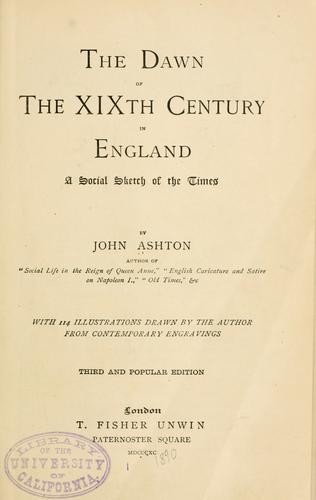
The Dawn of the XIXth Century in England: A social sketch of the timesAshton, John
History
The Dawn of the XIXth Century in England: A social sketch of the times
Ashton, John
England -- Social life and customs -- 19th century
The lid of the tinder-box being taken off, a piece of flint or agate,
and another of hard steel, were forcibly struck together, so as to
produce sparks. When one of these fell upon the tinder, it had to be
carefully tended, and blown, until it became a patch of incandescence,
sufficient to light a thin splint of wood some six inches long, having
either end pointed, and tipped with sulphur. You might be successful
at first trial, or, if the tinder was not well burnt, your temper
might be considerably tried. This was the ordinary mode, but there was
another—made with a pistol lock, having, in lieu of the priming-pan, a
reservoir of tinder. These two were combined with a small candlestick
which bore a wax-taper, and are frequently to be met with in
_bric-à-brac_ shops. Sometimes, also, in lieu of tinder, _amadou_ or
German tinder, made from a fungus, was used, or else thick and bibulous
paper was soaked in a strong solution of nitrate of potash, and both
were ignited by a spark from the flint and steel.
The first attempt to improve upon this machine, which was nearly as
primitive as an aboriginal “fire stick,” came from France, where, in
1805, M. Chancel invented a very pretty apparatus for producing light.
It consisted of a bottle containing asbestos, which was saturated
with strong sulphuric acid, and flame was produced by bringing this
into contact with matches of the ordinary type as to shape or very
slightly modified, coated at the ends with sulphur, and tipped with
a mixture of chlorate of potash and sugar. The phosphorous match,
too, was just beginning to be known. The following advertisement
probably refers to M. Chancel’s invention or some cognate method of
producing fire—_Morning Post_, December 27, 1808: “The success of
the Instantaneous Light and Fire Machines daily increases, and the
Manufactory in Frith Street, Soho, has become now the daily resort
of persons of the first fashion and consequence in town, who express
themselves highly gratified with the utility and ingenuity of these
philosophical curiosities.”
[Illustration]
[Illustration]
CHAPTER XXV.
Great fires in London—Number of Insurance Companies—Rates of
insurance—Fire-engines and firemen—Scarcity of water—Supply of
water to London—The streets—Their traffic—Shops—Watering the roads.
Public-domain text, read in full here on John Shaqi.
Reviews
Reviews
No reviews yet
Be the first to share your thoughts on this work.
Elsewhere in the archive
Join the Discussion
Join the discussion
Sign in to leave a comment or review.
Sign InorCreate an account