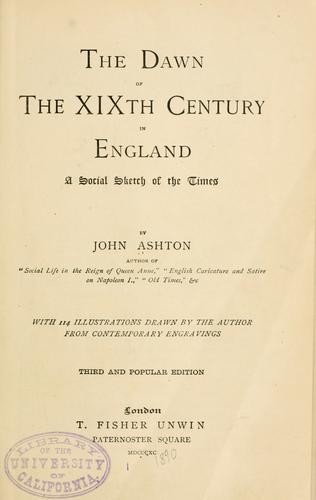
The Dawn of the XIXth Century in England: A social sketch of the timesAshton, John
History
The Dawn of the XIXth Century in England: A social sketch of the times
Ashton, John
England -- Social life and customs -- 19th century
THE transition from Matches to Fires is natural, and easy, and, during
the time of which I have treated in this book, there were several bad
ones. In 1800 on the 11th of February, three West India Warehouses,
near the Custom House, were burnt down, with an estimated loss of
£300,000; and on the 6th of October of the same year, thirty houses
were destroyed by fire. On September 27, 1802, an immense amount of
property was destroyed in Store Street, Tottenham Court Road. The great
tower over the choir in Westminster Abbey perished by flames July 9,
1803. The Theatres seem absolutely to have courted cremation. Astley’s,
which had been burnt down on September 17, 1794, was again made a ruin
on September 1, 1803, and forty houses shared its fate at the same
time. Then followed the Surrey, on August 12, 1805; Covent Garden on
September 20, 1808; and Drury Lane on February 24, 1809. These were
only the principal conflagrations during the decade; there were, of
course, as many minor ones as ever. Take one instance—the list of
fires within the Bills of Mortality for 1807. In the twelve months
there were 375 fires and 356 chimney alarms.
None could complain of want of Insurance Companies, for, in 1810, there
existed sixteen Fire Insurance Companies, _viz._, The Sun, Phœnix,
Royal Exchange, Hand in Hand, Westminster, London, Union, British,
Imperial, Globe, County, Hope, Atlas, Pelican, Albion, and Eagle. The
rates at which they assured were low, looking at the duty they paid
to Government—the Sun so paying, in 1806, no less a sum than £95,269
8s. 8d. Common Insurances were charged a premium of 2s. per cent.,
Hazardous Insurances 3s. per cent., and Doubly Hazardous 5s. per cent.,
or very much the present rate. And we must remember that money was
dearer, many buildings were of timber, and nearly all were faultily
constructed, there being no District Surveyor in these days—added
to which, the engines were but poor manuals; steam, of course, being
unknown.
[Illustration: A FIRE ENGINE.]
Public-domain text, read in full here on John Shaqi.
Reviews
Reviews
No reviews yet
Be the first to share your thoughts on this work.
Elsewhere in the archive
Join the Discussion
Join the discussion
Sign in to leave a comment or review.
Sign InorCreate an account