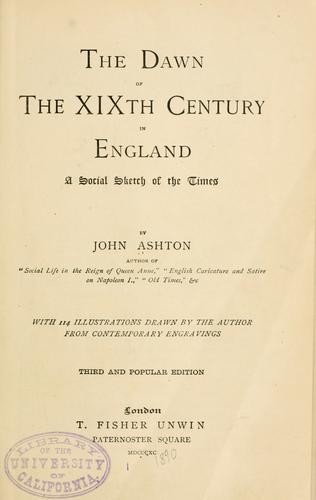
The Dawn of the XIXth Century in England: A social sketch of the timesAshton, John
History
The Dawn of the XIXth Century in England: A social sketch of the times
Ashton, John
England -- Social life and customs -- 19th century
“The child, itself, told a very artless and moving tale of its own
sufferings. The prisoner, it appears, used to strip him naked, and
flog him in the dust cellar, to make him go up the chimney, to which,
it seems, he had an utter aversion. When in the chimney, he was urged
to proceed by the prisoner having a stick, at the top of which was
fastened a pin, with which he goaded the poor infant; at other times he
would make the poor child descend into vaults, and used other cruelties
too shocking for recital. On inquiry at the workhouse, the child
discovered that his father is a smith by trade, a poor man, with six
children, living near Sloane Street. Its parents had used every means
to discover their child, and, at length found him in the workhouse. The
prisoner was committed to Tothill Fields Bridewell; and we suppose that
Mrs. Bridges, as soon as she can safely leave her bed, will also be
brought up to answer this charge.”
In 1803, if not before, there was in existence an “Association for
Improving the Situation of Infant Chimney Sweepers,” of which John
Julius Angerstein, Esq. (whose collection of pictures founded the
National Gallery), was the chairman.
May-day was also sacred to another class of early morning workers—the
Milkmaids. Curiously enough, the carriage and delivery of milk—by no
means a light task, whether looked at from the distance walked, or the
load carried—was entirely in the hands of women, strapping country
wenches, principally recruited from Wales. The cows were kept in hovels
in, and near, London, and a “milkmaid’s” daily life began at from 4 to
6 a.m. when the cows had to be milked; they then delivered the milk at
the various houses until near ten. Then there were the dairy vessels to
wash, and at noon, the cows again to be milked.
[Illustration: “HOT CROSS BUNS! TWO A PENNY BUNS!”]
The delivery of milk again occupied them till nearly 6 p.m., when they
had to wash up all cans, &c., for the morning. In 1808 it was reckoned
that about 8,500 cows were kept in London and its vicinity; one
cowkeeper at Islington owning between 800 and 900 cows. It is sad to
read, however, in 1804, that “Milk is sold at fourpence per quart, or
fivepence for a better sort; yet the advance of price does not insure
its purity, for it is generally mixed in a great proportion with water,
by the retailers before they leave the milk houses. The adulteration
of the milk, added to the wholesale cost, leaves an average profit of
cent. per cent., to the vendors of this useful article. Few retail
trades are exercised with equal gains.”
[Illustration: “DO YOU WANT ANY BRICK-DUST?”]
Following the milkwoman, would come the early Baker calling out “Hot
loaves!” and ringing a bell: he would appear on the scene between 8 and
9 a.m., selling his rolls at one, or two, a penny—in winter he added,
or substituted, muffins and crumpets.
Public-domain text, read in full here on John Shaqi.
Reviews
Reviews
No reviews yet
Be the first to share your thoughts on this work.
Elsewhere in the archive
Join the Discussion
Join the discussion
Sign in to leave a comment or review.
Sign InorCreate an account